When Ferdinand was 23 years old, two years before he became a naturalized citizen, he married Marie (Mary) Heiden of Bethlehem, Effingham County, Illinois. The date was October 19, 1882.
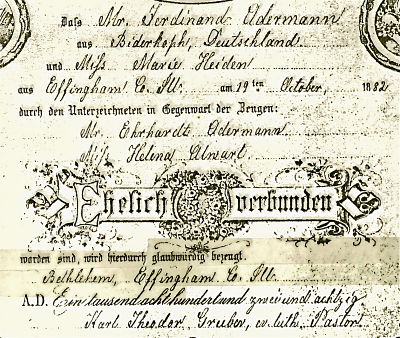
- Close-up of Marriage Certificate for Ferdinand and Mary Ann
Their marriage certificate is in German and states that “Karl Theodor Gruber, ev. luth [sic], Pastor” presided at their wedding. Mr. Ehrhardt Adermann was a witness to the vows as was Mifs. Helena Alwart. Mary’s mother’s maiden name was Margaret Alwerdt (Alwart). Possibly Helena was a cousin.
Just a few months later, on January 29, 1883, the young couple bought their first piece of land from Fred and Wilhelmine Engel for $475.00. The following year, their first son, Carl Martin, was born on May 31, 1884 and that autumn, on September 15, Ferdinand became a naturalized citizen. The two people who provided testimony on his behalf were (name illegible) Alwardt and Theodore Heiden, relatives of Mary (Heiden) Adermann.
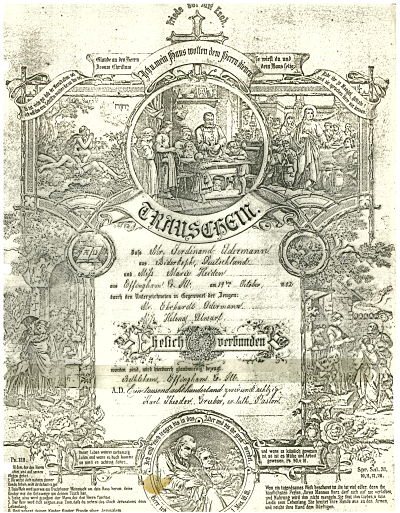
- Marriage Certificate for Ferdinand and Mary Ann.
Moving from Illinois to Daggett, MI, Carl bought 80 acres (two 40’s) for $1600.00 from the land agent. The land was not “virgin forest,” it had been cut years earlier, (that is called “cut-over” land) but there were many younger trees to cut. The soil was fertile, so it was worth the effort to clear the trees. Roy Westman, whose family was their next door neighbor in Daggett remembered that a fire had gone through the area three to four years earlier so there was lots of brush to move also. On the positive side, the land was still rich with lots of the berries which follow a forest fire.
Carl came up first to start preparing the land. He stayed with the Peter and Jurda Westman family who owned the 80 acres immediately to the east of the Aderman land. The Westmans had already built their farm, but were isolated from everybody else until the Adermans moved up. Carl “took his meals” with the Westmans during the several weeks of his first stay. After studying the land, he determined where to put the buildings.
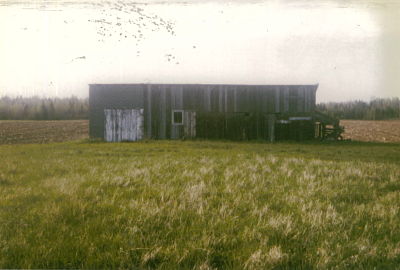
The machine shop Carl built and first lived in.
His first building was a shed made of 2x4s and drop siding. This became his temporary home and later was used as a granary and shop. He also worked to clear some of the land. At night, he would go back to the Westmans and sleep on a cot in their unfinished upstairs. The room had bare rafters and a rough lumber floor. It was here that the Westman children watched him “smoke tobacco”.
To read more about life on the farm, read this article written by their son, Edgar, who was raised on the farm.
Carl Martin Adermann was born on May 31, 1884 in Altamont, Effingham County, Illinois. He was the oldest child of Ferdinand and Mary (Heiden) Adermann. His father had immigrated from Biedenkopf, Germany and eventually moved to Illinois. Carl spoke only German as a small child and began to learn English when he first attended school. Even as a grown man, when he wrote home to his parents, he wrote in German. By the way, it is Carl in our lineage who began the tradition of spelling “Aderman” with only one “n.” A family story from the Illinois Adermans is that the Jewish Adermans used one “n” and the Gentile Adermans used two. Carl, a Lutheran, must not have known that tradition.
Carl met Floy Bates and they married. By the time he was 26, they lived in West Lincoln, IL according to the 1910 U.S. Census. According to his son, Oscar, they worked as farmers for a landowner. They rented the land and the family lived in a two-story house. They had 12 cows and two teams of horses for power. Corn was their major crop. The children walked over a mile to get to school. Carl grew disgruntled with the system they had because he had to work for two families. He supported his own family, but also supported the landowner’s family. In the rich farm land of Illinois, there was little chance of them ever owning a farm. Farms were passed on by inheritance or marriage, and Carl and Floy would not get one either way.
Their neighbors, the Capps family, moved to the upper penninsula of Michigan in 1914 or 1915. They sent word back tot he Adermans that the land was inexpensive and worth farming. In the fall of 1915, after the harvest was done, Carl went up to Wisconsin and Michigan via the Chicago and Northwestern passenger train (by way of Chicago) to look at land. He looked at Wausaukee first, but the land could not grow trees or shrubs. He concluded it also probably would not grow crops either, so went to the Daggett, Michigan area.
In 1888, 29 year old Prince Wilhelm became Kaiser Wilhelm II, leader of Germany. He has been remembered in history as an emotionally unstable person and a leader who was driven more by ego than care for the people of Germany. Martin Boerner, 22 years old when Kaiser Wilhelm took charge, was serving in the German army. He did not like the tone of the new leader and was concerned about the course the Kaiser was on–one that led to World War I. Nine years later, Martin discerned it was time to leave Germany and join his brother, Bartle, who had already immigrated to Milwaukee, Wisconsin.
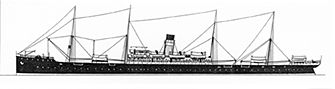
The Southwark, the ship on which Martin Boerner sailed to New York.
According to the passenger list of the ship, The Southwark, Martin was a farmer who bought his own ticket for the United States and had more than $30 with him for the journey. The ship left Antwerp on November 21, 1897 and arrived in New York on December 1, 1897. There he was processed through Ellis Island before leaving to join his brother.
Martin was married at the time and left his wife, Katharina, and their three young sons behind in Gaulsheim, Germany. Those sons, Johann, Jakob, and Karl joined their mother two years later on a journey to the United States to join Martin.
On October 23, 1846, three generations of the Michael Hope family arrived in New Orleans, LA to begin their life in the United States. They were all born in England and made the journey on the ship, Hope of Dunbury*, leaving Liverpool for their new country. According to the ships passenger manifest, Michael Hope, age 58, and his wife Margaret, age 63 were on board the ship with their son Michael, age 30, and his wife Elizabeth, age 36. Traveling with them were their children Michael, age 6, John R. age 4, and infant Margaret.

- Passenger List of the Hope of Dunbury showing the Hope family*.

*New Orleans Passenger Lists, 1820 – 1945.
For years, the family story about Ferdinand Aderman coming to America was that as a teenager he stowed away on a ship from Hamburg, Germany. His uncle was a paying passenger on that same ship. Ferdinand was not discovered until later into the journey and it was too late to return home, so his uncle paid his fare and Ferdinand was indentured to him for the first six years after they arrived in the U.S. It is a fun story. It also keeps this writer from getting too judgmental in the current illegal immigration conversation.
His obituary reported that he came with his mother and younger siblings. When did he immigrate? According to:
- the 1900 Census, he came in 1869;
- the 1910 Census states he immigrated in 1876 at the age of 17;
- the 1920 Census reports him coming in 1870.
There is an account of a Ferdinand Adermann, aged 20 and a butcher by profession, coming over on the Rhein to New York on November 29, 1878. This is four years older than our Ferdinand would have been in 1878. There were no other Adermanns on the ship so that passenger traveled alone. Why the discrepancies? He spoke German even into adulthood—maybe he did not understand the question. Maybe he did not care enough about the date to remember it. Maybe . . .
His son, Wilbur (Feeley), wrote that his father immigrated when he was 15. That would put his arrival in 1875 or 1876. That is not consistent with any of the census or passenger lists data. This is a curiosity that needs more attention.
What we do know: he became a naturalized citizen of the United States, the State of Illinois, in Effingham County on September 15, 1884. As part of his naturalization papers it states that he “arrived in the United States a minor under the age of twenty-one years, has resided within the limits and under the jurisdiction of the United States for and during the full term of five years, including the three years previous to his arrival at the age of twenty-one years, and one year within the State of Illinois; . . .”
Welcome to the first post of this blog on the Aderman/Hope/Boerner/Woodington family trees. I will be adding stories and pictures, historical information and whatever fun, interesting discoveries come my way. All of this is intended to help the family know Whence We Come. I hope you have fun discovering our ancestors’ stories.


 Whence We Come