With the recent passing of another Thanksgiving celebration and arrival of the first significant snowstorm of the season, this writer’s musing have gone to the Donner Party tragedy during the winter of 1846/47. This was the group of emigrants who left Sangamon County, IL in 1846 to move to California, a land which still belonged to Mexico until the next year. Through a series of unfortunate decisions and difficult weather conditions, they got trapped in the Sierra Mountains of California over the winter without enough food or protection from the weather. The group was 81 people strong at their peak, but only 45 survived being stranded in the moutains. As members died in the deep of the winter, toward the end of the ordeal the others, starving and desperate to survive, had to resort to cannibalizing the bodies of those who had passed away. After they were rescued and the news of their plight got out, the Donners and others associated with them were badly maligned throughout the nation. It even brought immigration to California to a virtual standstill for a few years until the Gold Rush of 1849 got it going again.
Two websites which got me started exploring this are the Donner Party Diaries and Legends of America. Kristin Johnson has done much scholarly research on the Donner Party and her blog is probably the most accurate with current research. Charles Fayette McGlashan published a book in 1879 (yes, 1879) entitled History of the Donner Party: a Tragedy of the Sierra. This book is available through Google’s eBooks. In 1911, Eliza P. Donner Houghton, the daughter of George and Tamzene Donner and just four years old when she survived the winter trauma, wrote her remembrances of the experience in the book, The Expedition of the The Donner Party and Its Tragic Fate. Kristin Johnson also was a contributor to a new book, An Archeology of Desperation, which can be ordered on Amazon.com (edited by Kelly Dixon, et.al.). Why my interest? We are distantly related to the family.
In this first post about the Donner Party, allow me to make the family connection. Some of the heritage of Floy (Bates) Aderman, wife of Carl Aderman, was described briefly in an earlier post, addressing her connection to the Blue Family. Research by the individuals in the National Blue Family Association take that part of the family tree back to the 1600s. Our Blue ancestors left Brazil (with Dutch heritage) and came to “New Netherlands,” the colony which became known as New York later in that century after James, the Duke of York (and brother of England’s King Charles II), asserted his claim to the territory.
John Blew (1691? – 1770) and his wife, thought to possibly be Cattron Van Meter, had five children: John Blue was the oldest, then Michael, Uriah, Abraham, and Mary. Floy Bates Aderman’s lineage comes through Uriah (1726 – 1806). Uriah was the father of John S. Blue (1750 – 1833), a veteran of the Revolutionary War. John S. Blue married Margaret Wallingsford and among their ten children were Robert and John Blue, Floy’s great-great grandfathers as mentioned in that earlier post. Uriah’s older brother, Michael Blue (ca. 1720 – 1819) was the great grandfather to sisters Mary and Elizabeth Blue.
Mary Blue was married briefly to Charles Tenant in Sangamon County, IL. They married in 1828 but she married George Donner in 1829 so that first marriage ended quickly. George and Mary had two children, Elitha Cumi Donner (1832 – 1923) and Leanna Charity Donner (1834 – 1930). Mary died before the Donners made the trip west and George married a third time to Tamzene Eustis. Both of Mary (Blue) Donner’s daughters went with their father on the journey to California and survived the terrible winter in the mountains, although they were left orphans. Elitha married one of the rescuers, Perry McCoon (1821 – 1851). He died a few years later in a horseback riding accident.
Elizabeth Blue had married James Hook in 1829 and they had two sons, Solomon and William. That marriage ended in divorce when James abandoned the family. She then married Jacob Donner, George Donner’s younger brother, in 1835 in Sangamon County, IL. Betsy and Jacob had five children. Both Betsy and Jacob died that winter in the Donner Pass tragedy, as did three of their five children and Betsy’s son, William Hook. William, 12 years old, was rescued on the “First Relief” (the first of three rescue efforts) but apparently died within days of “overeating at the Bear Valley on February 28, 1847.”
Solomon, her oldest child, was about 12 years old that winter. He suffered greatly on the trip but did survive. In Eliza Donner Houghton’s book, The Expedition of the Donner Party and its Tragic Fate, she wrote in Chapter XI:
“For the time, [John Baptiste–a fellow traveler] lived at Aunt Betsy’s tent, because Solomon Hook was snow-blind and demented, and at times restless and difficult to control. The poor boy, some weeks earlier, had set out alone to reach the settlement, and after an absence of forty-eight hours was found close to camp, blind, and with his mind unbalanced. He, like other wanderers on that desolate waste, had become bewildered, and, unconsciously, circled back near to the starting point.”
Having made the family connection and hopefully, gaining your interest, other posts will follow about their experiences moving from Sangamon County to California.
Floy (Bates) Aderman (1889 – 1960), wife of Carl Aderman, was the daughter of Robert Josiah Bates (1853 -1926) and Marga Ann “Margie” Radley (1857 – 1911). As a girl, she and her siblings learned a table prayer from their parents. This prayer was found again just a few years ago, written in Floy’s handwriting, and stored in an attic trunk. It had become a standard prayer at many of Carl and Floy’s family gatherings over the years. As we prepare for the upcoming Thanksgiving holiday, here is the Bates/Aderman family table grace.

- The Bates Family Table Grace in Floy’s handwriting.
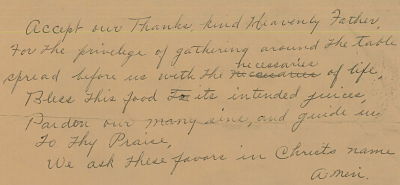
The Prayer:
Accept our thanks, kind Heavenly Father, for the privilege of gathering around the table spread before us with the necessaries of life. Bless this food to its intended juices, pardon our many sins, and guide us to Thy praise. We ask these favors in Christ’ name. Amen.
On this Veterans Day Weekend, it is appropriate to remember the military service of one of our family. Donald Aderman, of St. Joseph and Lincoln, IL, was the son of Paul and Florence (Gallagher) Aderman, the grandson of Ferdinand and Mary (Heiden) Adermann. Born on September 1, 1921, he was 59 years old when he died at home from heart failure on January 27, 1981.
During World War II, Donald served on General George Churchill Kenney’s personal plane. According to his obituary, he served for over three years and was a flight engineer; on the website about Gen. Kenney, he was noted as a side gunner. (The pictures below are from that website.)
General Kenney became the Commander-in-Chief of the 5th Air Force, USAAF and had oversight of the South West Pacific Area, serving as the senior Allied air officer under General Douglas MacArthur, who had responsibility for the whole Pacific theater. His “office” was a refurbished B-17 Flying Fortress he affectionately called “Sally” in honor of his wife. Kenney took over his responsibilities in 1942 and Donald Aderman served with him through most of the latter’s military service. General Kenney is credited with turning around the work of the Air Force in the South West Pacific, using creative strategies which effectively threw off the Japanese and forced them to waste resources in ineffective fighting. His forces fought in the Philippines, Borneo, New Guinea, and Dutch East Indies.

Don Aderman on the crew of the Sally. General MacArthur is awarding Gen. Kenney the Distinguished Service Medal, with the crew of the Sally watching.*
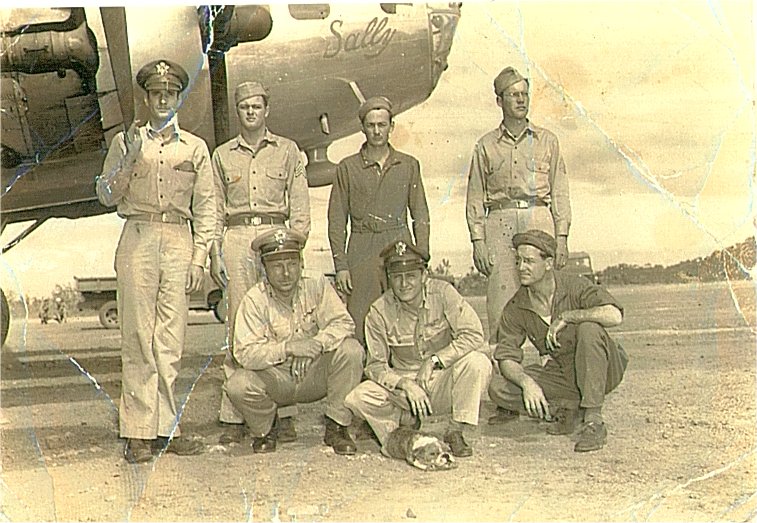
The crew of the Sally and their mascot, Butch. Don Aderman is standing in the back row, second from the left.

Another picture of the crew of General Kenney’s “Sally.” Don Aderman is the third from the left. Butch, who frequently accompanied them on flights, sits in the foreground.

The “Sally”–the B-17 Flying Fortress which was General Kenney’s office during WWII.
Donald married Mary Garton on March 25, 1945 in Lincoln, IL and after the war, he worked for Central Illinois Light and Gas Company. He was also active in the Lion’s Club, Lincoln Chamber of Commerce, Lincoln American Legion Post 263, and the Quarter Century Club of Springfield.
*All of these pictures are from http://www.ozatwar.com/usaaf/sally.htm.

Moses Woodington
In an earlier post, the Civil War service of Moses (26 Oct 1837 – 18 Feb 1919) and Jonathan (16 Dec 1842 – 13 Oct 1918) Woodington was explored. The brothers mustered in (entered) the Army on January 30, 1865 and mustered out (were honorably discharged) the following fall on November 15, 1865. They completed their service in Austin, Texas and then were left to find their way back to southwestern Wisconsin.
About twenty years after the war, Moses applied for a veteran’s disability. His first attempt was denied, but his next application was accepted. The disability application was an extensive process including proof of his identity, proof of his service as a veteran, notarized reports by witnesses who knew him before and after the war and who knew of his disability (and that the disabilities were not from “vicious habits”–a phrase used frequently throughout the paperwork), signed reports by physicians, and Moses’ own testimony of when the diseases occurred and their ongoing effects.
The basis of his claim to disability was that when he was serving in Memphis, TN in May of 1865, he suffered a sunstroke while “getting out timbers for barracks.” He also contracted “disease of the eyes” that one physician’s report said was consistent with Trachoma. Additionally, he suffered “malarial poisoning” which was treated in camp and while he marched and which apparently also made him susceptible to carbuncle infections on his neck. When the Regiment arrived in Alexandria, LA in July, Moses came down with Bilious Fever, a recurring fever marked by diarrhea and vomiting. All of these continued to trouble Moses for the rest of his life.
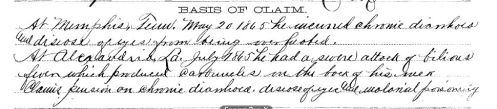
- The basis of Moses’ claim for disability from his Civil War military service.
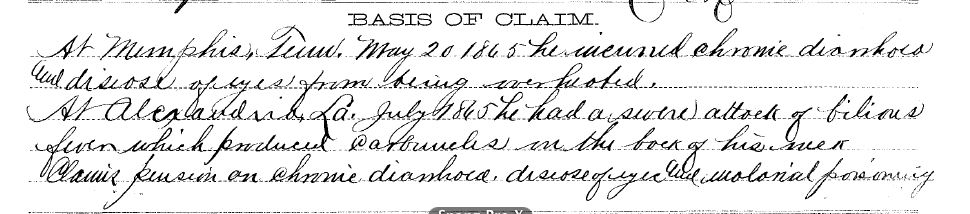
By the time of his application for disability, he was also suffering rheumatism with swollen knees, hips, shoulders, and fingers. About 70% of the deaths in his Regiment were from disease–a statistic too common for soldiers in the Civil War because of the terrible living conditions and poor hygiene. Clearly, it had lifelong consequences for Moses.
A few years after he returned home, Moses was working at a sawmill and lost some fingers on his right hand. As he wrote the story when he amended his application for disability, “under the new law by alleging loss of fingers of right hand which was caused by a circular saw in a saw mill in which I was there engaged as a sawyar (sic) a man spoke to me and as I turned to answer him the saw struck my hand and cut off three fingers about June 15th, 1868.” Later medical reports stated that the third and ring fingers were cut off close to the hand and his little finger was amputated at the second knuckle.
Moses did get disability and the monthly payments gradually increased as he aged and as the Federal government increased payments with economic changes. Eventually, heart disease and arteriosclerosis were also added to his health issues. His government benefits covered the medical care he needed in the last few years of his life and also paid for most of his funeral costs.
According to family stories, in 1847, this writer’s great-great maternal grandfather, John Sturmer, immigrated to the U.S. from Neufilzen, Rhineland, Germany (also known as Prussia) with two of his brother and two sisters. His brothers were named Peter and Jacob. They spent two years farming in New York before eventually moving to Grant County, WI.
Peter married Mary Hull and they had three daughters, Susan, Catherine, and Mary. In 1850 they were living in Distrist 24, Grant County, Wisconsin.

- 1850 U.S. Census showing the Peter and Mary (Hull) Sturmer Family.

Sometime after that, Peter and Jacob went to California to try their luck in the Gold Rush. Peter left his wife and young daughters in Grant County with the intention of returning to them after he had found some gold. According to an account in the Grant County Independent of August 19, 1949:
“About Peter Sturmer is told a strange story, which might be classed by some as imagination, but the family gravely insisted the details were true.
“Sturmer was not killed in the gold mines or camps and it is most certain that he gathered gold in some form while in California. A letter by his brother Jacob, who was also in quest of gold, told of his departure for Wisconsin.
“Peter’s two small daughters, Catherine and Mary, counted the days until his return. About the time he was to have arrived home, they became impatient and while playing out of doors, they cried out in their native German, ‘Hier is der Vater, yo’–‘Why, here is Father.’
“Rushing to the door, their mother expected to see her husband. Bitterly disappointed that no one was visible to her, she turned to the children, who insisted they had seen their father.
“Some time later, Mrs. Sturmer received word that her husband had been killed along the trail, murdered for the gold he was taking home to his family. And the vision of their father which appeared to the little girls occurred about the time he lost his life.”
John Boerner arrived in Wisconsin from Germany with his mother and younger brother in 1899. He was raised in Niagara, WI and as a young man he returned to Germany to marry his cousin, Hildegard Boerner (that was also her maiden name), and bring her to the United States. They arrived back in the U.S. on May 21, 1912 on the ship, the Kroonland*, but were detained for one day. They were considered “LPC” or “Likely Public Charge.”
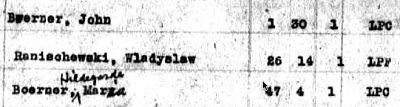
- Ship’s Manifest showing John and Hildegard detained for “LPC.”
In 1891, the U.S. Government added another filter to the flood of immigrants coming into the country by considering if they had means or potential for becoming productive, gainfully employed citizens. If they had family in the country who would help them get established or if they had some wealth of their own, they would be admitted into the country; if those conditions were not met, they could be detained and/or deported so that they did not become a “public charge,” i.e. someone needing the welfare care of the state. John and Hildegard fell into that category until they could prove otherwise. It took only a day for them to show they either had some means or family to help them; they were admitted into the country the next afternoon. It was noted that John was a U.S. Citizen and Hildegard either was a U.S. Citizen or was in process (I am not able to make out the hand-writing).
When World War I began, there was a national draft and John registered for the draft** like other young men. He was employed at Kimberly-Clark in Niagara, WI as a labourer [sic] at that time. His Registration Card noted that he had been born in Gaulsheim, Rheinhessen, Germany, was married and had two children.
By 1930, the couple had moved to Kohler, WI. They established themselves there and were raising their children to be active participants in the community. (There are hundreds of times their names are listed in the Sheboygan Press, the county-wide newspaper, reporting the different ways they were engaged in community activities.) The 1930 U.S. Census reported that 41 year-old John and Hildegard (age 38) lived on West Park Lane in Kohler with their five children Martin (16), Jacob (11), Margaret (9), Elizabeth (7), and John, Jr (1 yr, 1 month). Also living with them were two brothers-in-law of John’s (presumably Hildegard’s brothers) John W. (age 51) and Joseph (25), both single. The Census also tells us the couple both spoke German in their homes before coming to the U.S. and that Hildegard was naturalized in 1912, the same year as her arrival in this country. John worked as a grinder and Hildegard was also working outside the home doing clerical work.
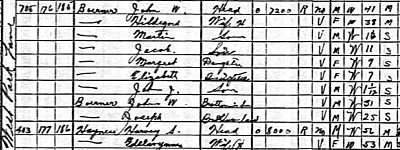
- 1930 U.S. Census for John and Hildegard Boerner Family
A question which still needs more digging: when and where did John and Hildegard marry? I have reviewed the available data I know and find no hints. More to come . . .
*New York Passenger Lists, 1820 – 1957.
**WWI Draft Registration Cards
Recently I wrote about John Dull and his son, Thomas, who mustered into Co. H of the 1st Iowa Cavalry in 1861. John was a farrier for the Company and died on October 19, 1863 of “Remittent Fever” in the General Hospital, Little Rock, Arkansas.
According to the 1890 U.S. Census “Special Schedule” for Veterans, Thomas remained in the Cavalry until Feb 18, 1866. He served 4 years, 8 months, and 2 days. At the time of this federal Census, Thomas was living in Omaha, NE. There is also an interesting comment on the bottom of the form stating that he incurred a disability when he was shot in the arm during his service.
His wound was significant enough that he applied for disability in 1889, the year before the special Census. He died on August 18, 1913 in Iowa and ten days later, his widow applied for the Widow’s Pension.*
Maria, John’s widow and Thomas’ mother, had applied for the Widow’s Pension** soon after the death of her husband. This pension application was an extensive process, requiring proof of marriage from the Clerk of Court in the County where the marriage took place, proof by the Surgeon General of the United States of her husband’s death, proof of his enlistment in the military by the Office of the Adjutant General, and two witnesses from her community speaking to her credibility as an applicant. Maria was able to get those forms and received a pension compensation of $8.00 per month. Although the approval for her application took six months, it was retroactive to the day after John’s death the previous October.

- A snapshot showing final approval of Maria Dull’s Widow’s Pension

*Fold 3: Civil War and Later Veteran’s Pension Index for Thomas H. Dull.
**Fold 3: Civil War “Widow’s Pensions” for Maria Dull, widow of John Dull, Co. H, 1st Iowa Cavalry.
After Carl and Floy (Bates) Aderman moved to Daggett in the Upper Peninsula of Michigan, they found themselves surrounded by forest. They had to clear the land in order to plant their crops; in the winter, Carl would go to work in the lumber camps. They heated with wood, they cooked with wood, they built with wood. It was plentiful and a renewable resource.
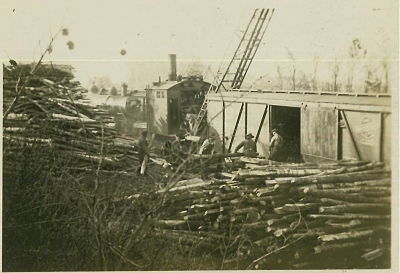
Lumber Camp found in Oscar’s pictures.
Their boys got good at handling wood from a very young age. In the winter, when Carl was gone to the lumber camps, it was up to the boys to get wood to the house so they could keep the house warm and their mother could cook meals in their wood stove.
The forests also supplied wood for the Kimberly Clark paper mill in Niagara, WI, where Carl, and sons Oscar, Virgil (Red), Edgar, and Edwin all worked. In the early years, the mill preferred spruce and balsam logs from Canada because they were more fibrous and better with which to make paper. (Later, as technology improved they shifted to more readily available poplar trees.) One of Oscar’s first jobs at the mill was running the steam crane in the wood yard, moving logs from the wood piles to the pond in preparation for the first step of paper-making.
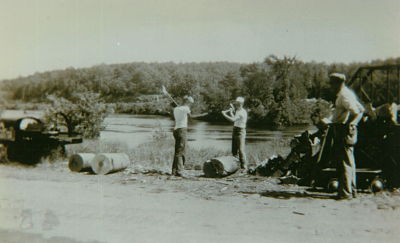
Oscar and sons cutting wood by the Menominee River.
Wood was also crucial for Oscar and Ann’s family and a primary source of heat. The family lived near the river and would cut logs from the river side. The boys would row up the river in their boat and choose which trees they would get. When they had ear-marked the trees they wanted, they would row back down the river and cut one tree, pound a stake in it and drape a tire chain over the stake. They would row further back down the river, cut the next tree and pound a stake in it, then drape more of the tire chain over that log. Down the river they would row, cutting logs and holding them together in a raft-like form with the tire chains draped over the stakes, holding them together.
Once back to shore near the house, they would use a cross-cut saw to block up the logs, split them, and bring them to the house. The logs were stored in the basement and were thrown down there through a chute from the outside of the house.
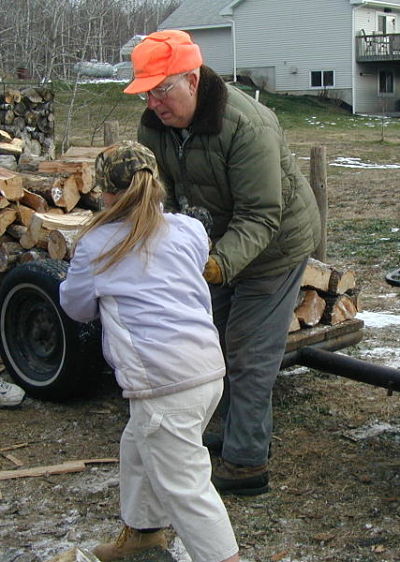
The Fifth Generation loading wood onto the wagon.
The tradition continues. Oscar’s sons continued to use wood heat as do several of their children. The fifth generation is now learning how to work with wood. It is a generous resource in northern Wisconsin and as Oscar used to remind us, “think of how many times this wood heats you up before you ever get it in the stove!”
Harry Durheim, born on February 20, 1916, was the son of Ida and Fred Durheim. His mother died when he was 7 months old and his grandparents, Ferdinand and Mary (Heiden) Adermann raised him. By the time he was 21 years old, Harry was playing Minor League Baseball. According to his stats, he was 6’0″ and weighed 164 pounds. He threw and batted with his right hand.
Harry played six seasons, beginning in the “D” level teams and working his way up to playing for the Indianapolis Indians (a AA team) in 1945 at the age of 29. He was a pitcher and played 11 games that season, winning 8 of them for a win/loss percentage of .727. He was ranked 29th out of the top 100 pitchers in the league in 1945. It is fun to track his journey by beginning at Baseball Reference.com.
The Indians came in second place that season (behind the Milwaukee Brewers who were not yet a Major League team) and also competed against the Louisville Colonels, the St. Paul Saints, Minneapolis Millers, Toledo Mudhens, Kansas City Blues, and Columbus Red Birds. They were associated with the Boston Braves of the National League.
Harry married Gertrude Budde and they had one daughter. According to the notice of his death in the Effingham Daily News on January 20, 1964, he worked in the plumbing business and had coached basketball for 12 years at the Immanuel Lutheran Church Grade School. He died on January 18, 1964 at the age of 47 when the car he was driving slid on the icy road and ran into a utility pole.
We are currently in the midst of Major League Baseball playoffs and that has me pondering the role of baseball in our family history.While it seems as though recently football has usurped baseball as the “great American past time,” for most of the 20th century, baseball was indeed America’s game. Babe Ruth set the bar for baseball players for many decades. Joe DiMaggio and Lou Gehrig were the heroes of boys everywhere. Informal games were played in school yards, sandlots, and farm fields; people listened to games on the radio and boys across America dreamed of playing in the “big leagues.”
In their downtime from farming and lumbering, the boys and young men would enjoy a game of baseball amongst themselves.

Playing Baseball on the Daggett, MI Farm
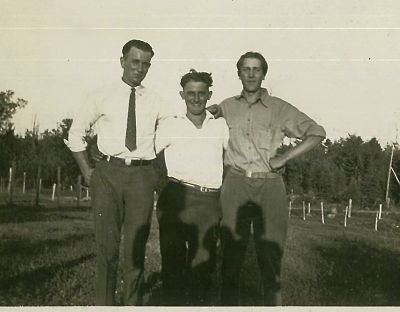
Oscar, Unknown, and Biz (Loren)
Last week I found a picture with the caption on the back saying, “Well, I declare! Part of Daggett’s first baseball team.” Oscar and “Biz” (Loren) Aderman and an unknown third man (standing in the middle) are shown in the picture. Oscar was the catcher until he got hit in the face with a ball and had trouble overcoming his skittishness after that. His baseball glove was quite small and poorly padded by today’s standards. Oscar had large workman’s hands–the glove would have been a tight fit for him.
Oscar’s son tells of playing catch with his Dad. Of course, he was sure his Dad was “out of it” and would not know a thing about baseball. He was surprised and humbled when every kind of ball he threw at his Dad was caught–his Dad was really good at baseball!
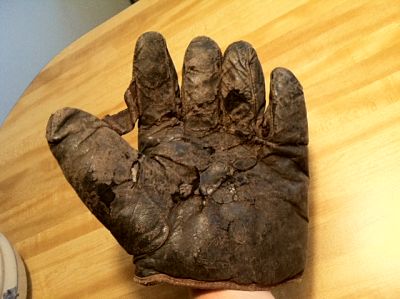
Oscar’s Baseball Glove
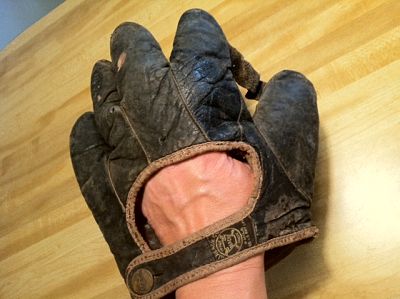
Top view of Oscar’s Baseball Glove
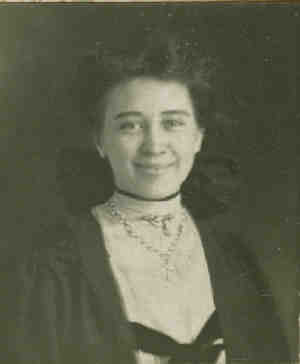
Ida (Adermann) Durheim
Ida Adermann (b. July 7, 1888) married Fred William Durheim on June 30, 1912 when she was just a week shy of her 24th birthday. Three years later they were pregnant with their son, Harry, and on February 20, 1916 Harry was born. That fall, in September of 1916, Ida was stricken with a bacterial disease known as Erysipelas. It is caused by a more dangerous form of the bacteria Streptococcus and this was before the use of antibiotics for infectious diseases. Especially at that point in time, it was most common for the red rash to attack primarily the face and neck. This is what happened for Ida.
The young couple had moved to Decatur in Macon County, Illinois. According to the death certificate, she first went to the doctor for her rash on September 11, just a few weeks before her death. The doctor continued treating her through September 25 and it was thought she was improving from the infection. Then, four days later, on September 29, she passed away from “exhaustion and heart failure following severe attack of erysipelas of face and head.” She would have suffered greatly from the disease and left behind her husband and seven-month old son, Harry. After her death, Ferdinand and Mary took in their grandson, Harry, and raised him.
- Henry C. Aderman
Henry Aderman, son of Ferdinand and Mary (Heiden) Adermann, died at the young age of 23 when there was an explosion at the coal mine at which he worked. The Altamont News reported “he was helping to remove slack when an explosion took place, causing him and two other workmen to fall into the crater of a small volcoma.”
Following is a news article about the tragedy and some of the published obituaries at his death. This information comes from Our Family Genealogies.
BLAST VICTIM BADLY BURNED
Small hope was held forth late last night for the recovery of H. F. Aderman, Lincoln man, who with two others was injured yesterday morning by a terrific explosion of the refuse pile at the Peerless Coal company mine, two miles northeast of the city. Spontaneous combustion is believed to have caused the blast.
Badly burned on the body and his lungs weakened by gas, Aderman’s condition was termed as critical by physicians at St. John’s hospital.
Aderman and J. F. Ingram, also of Lincoln, were probably saved from instant death by the action of the foreman, Fred Bane, Rural Route No. 8. Himself blinded and almost suffocated by the gas, Bane ran to their assistance and aided them in getting away from the miniature crater that was shooting flames to a great height.
Ingram, whose home address is 322 North Sherman street, Lincoln, was burned on his face and suffered from the gas. Bane was gassed while rescuing his two companions. Both Ingram and Bane were taken with Aderman to the hospital where they are receiving treatment. Their condition is not dangerous.
WORK ON SHOVEL CREW
The Lincoln men were employed with the steam shovel crew at the mine, until recently known as the Jones & Adams and were temporarily residing in this city. Their wives were notified of the accident and came to their bedsides in the afternoon. Aderman’s home in Lincoln is at 1106 Sixth street.
Following the blast, the entire refuse pile became a mass of flames and a shovel outfit valued at $7,000 was completely destroyed.
The explosion was of peculiar origin Foreman Bane, of the crew, stated that he had never known of such an accident before. The men were working on top of the pile of shale and the shovel sank into the smoking interior. There was a puff of gas and flames arose, the action resembling a volcano.
FEW MEN AT MINE
Rain and change of weather is supposed to have caused combustion. The dampness of the pile is believed to have acted on the sulphur and other minerals until when air reached the smouldering mass it broke into fire. Few men were at the mine at the time of the accident, because no work underground was scheduled for the day.
(Previous article from Illinois State Journal, 21 May 1919, p.13, Springfield, Sangamon, Illinois, USA)
Notice of Death: HENRY A. ADERMAN
Aderman, Henry A. at 2:40 a.m. Wednesday, May 21, 1919, at St. John’s hospital of accidental injuries, at the age of 23 years. Remains removed to Bisch’s, and last night taken to the home at Lincoln where funeral services will be held and interment made.
Surviving are his wife, Mrs. Leatta Aderman; two sons, Raymond and Virgil; one daughter, Marie; his parents, Mr. and Mrs. Fred Aderman; four brothers and five sisters.
(Previous obituary: Illinois State Journal, 22 May 1919, p. 7, Springfield, Sangamon, Illinois, USA)
OBITUARY OF MR. HENRY ADERMANN
Henry Adermann, son of Mr. and Mrs. Ferdinand Adermann, was born at Altamont on April 21, 1886 and died as a result of an accident which occurred at a mine near Springfield on May 21, 1919, his age being thirty three years and one month. He was helping to remove slack, when an explosion took place, causing him and two fellow workmen to fall into the crater of a small volcano. His burns, severe indeed, caused his death after several hours of agony.
He was married to Miss Lotta Cross and to this union two sons and a daughter were born. In addition to the sorrowing wife and children, Mr. Adermann leaves his parents, five sisters and four brothers to mourn his sad and unexpected departure.
Mr. Adermann was confirmed in the church of his parents, the Lutheran Church, when a young man and he was honest, industrious citizen, a good husband and a loving father. His wife, children, parents and brothers and sisters are in deep sorrow over his tragic end. They need and have our sympathy.
Funeral services were conducted from the residence of the parents on Friday afternoon last by Rev. W. H. Day, pastor of the Presbyterian Church. Burial was at Union Cemetery.
(Previous obituary: Altamont News, 4 Jun 1919, Altamont, Effingham, Illinois, USA
His Family Adjusts
Henry had married Lotta Cross in 1913 and they had three children at the time of his death. They were pregnant with their fourth child, Lawrence, who was born and died on January 11, 1920. According to the Illinois Death and Stillbirth records, Henry had been a fireman.
Soon after his death, Lotta and her children moved to Kincaid, Jackson County, IL. According to the 1920 U.S. Census, she was living with her mother, Samantha Asbury, age 61. Samantha was the grandmother of the three children and had another grandson, Milton Cross, living with her as well. Samantha was also a widow at that time.
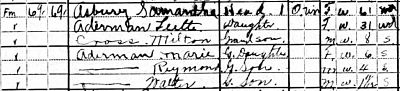
- 1920 US Census showing Lotta and children living with her mother.
By the time of the 1930 U.S. Census, Lotta had married Harry LeRoy Gregg and moved to Redondo Beach, Los Angeles County, CA. She and the children lived the rest of their lives in California.*
*California Death Index, 1940 – 1997; Ancestry.com files.
Written in January, 1956:
Obituary:
“Ethel Barbara Woodington was born July 10, 1890 in Cassville, Wis. to Furman and Clara Sturmer Woodington. A graduate of Cassville High School in 1908, she attended Platteville Normal and taught in the Beetown area for several years. She married Monroe Hope, May 28, 1919 and three daughters were born to this union, one dying in infancy; the others, Florence C. (Mrs. J.C. Neises) of North Andover and Marion (Billie, Mrs. O.D.Aderman) Shell Lake, Wis. In addition to her husband and daughters, she is survived by four granddaughters and three brothers–Wm Jennings Woodington, Deerfield, Wis; Marc, Cassville; and Robert J. of Cassville, Missouri. Mrs. Hope’s parents and two brothers, Roland and Walter, preceded her in death. Mrs. Hope was a member of O.E.S. [Order of the Eastern Star], Bloomington Chapter 78, Royal Neighbors, Womans Club where she was the current Treasurer, Baptist Women’s Union and the Music Benefit Club. She has served as chairman for many of the drives, such as Cancer, Heart, and Red Cross.”
A Tribute to Ethel Hope:
“On this pilgrimage called human life, we sometimes meet a rare spirit, gentle and unassuming but so aligned with principle as to make her influence far reaching. So with Mrs. Hope. Her home, family and garden formed the center of her life, but not its circumference. Her community meant much to her, church, school and women’s activities called out her best gifts–tact, perception, graciousness, and a strict regard for the most minute detail. As teacher she commanded both the respect and love of her pupils. She had delight in a simple things–sunshine and shadow on her beloved bluffs, a rose, the perfection of a tiny baby–these brought quick tears of appreciation. A flashing wit, but a kind one, she laughed with not at people. She ‘improved earths preparatorey school to the utmost’ and truly ‘her works so follow her.’
“‘The sunset on which we gaze is a sunrise on the other side of the world and the vanishing days can take from us nothing that may not be restored by some day yet unborn.'”
Power Short Burns Man
Special to the State Journal
Lincoln, May 26, 1957—A 6900 volt power line in Lincoln was shorted today by a lineman, Paul Aderman, 58, and an “arc of fire” set his clothes afire, burning them off his body. He is in critical condition in Abraham Lincoln Memorial hospital.
Aderman was on top of a ladder at the time, repairing a line at 6:20 p.m. in an alley on Walnut St. in Lincoln, between Fourth and Fifth Sts. His partner, Morrell Delbert, Mt. Pulaski, said a wrench on Aderman’s safety belt apparently hit the 6900 volt line.
“An arc of fire seemed to play around his body,” Delbert said, “then his clothes caught fire.” Aderman was knocked out for a few seconds, but managed to hold to the ladder. Delbert and George Hoagland, another lineman who lived nearby, and Dave Shea, resident of the area, rescued the burned man. Delbert’s fingers were burned as he brought Aderman down and helped beat out the flames.
Central Illinois Electric and Gas Co. technicians pulled the switch that cut off power to the entire city of Lincoln, when they learned of the accident. It was not restored for about 90 minutes. Power was cut to the two hospitals, and only Abraham Lincoln Memorial has an emergency generator for lights only.
Aderman was taken to the hospital in the Lincoln fire department’s civil defense ambulance. Doctors said he has second and third degree burns over 65 percent of his body but believe he will survive.
This was the second accident for the veteran lineman. He was badly burned about 30 years ago in a similar accident.
The accident did prove fatal for Paul and he died on June 10, 1957. Having been born on April 2, 1899, he lived 58 years.
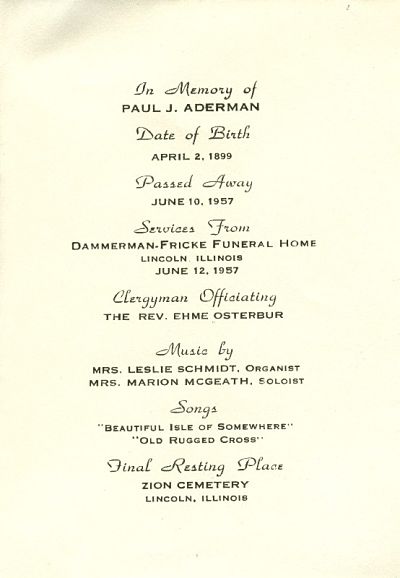
- The funeral home remembrance note for Paul.
Mrs. Aderman of Altamont is Dead
June 27, 1940
Spent Last Winter With Daughters Here.
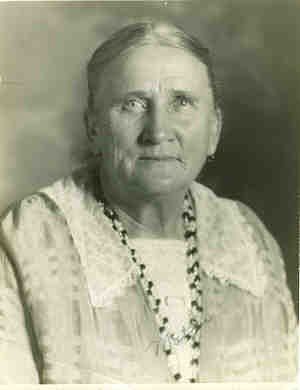
Mary Heiden Adermann
Mrs. Mary Aderman of Altamont, mother of Mrs. Henry DeJong and Mrs. George Smith of Springfield, died at 1:50 p.m. Thursday at her home. She was 76 years old. Mrs. Aderman was a lifelong resident of Altamont.
A frequent visitor to Springfield, Mrs. Aderman spent last winter at the home of her daughter, Mrs. DeJong, 1225 East Brown Street, and has many friends in this city.
Survivors, besides her two daughters in Springfield, are two other daughters, Mrs. Cecil Bridges and Mrs. Leonard Yocum, Detroit, Mich.; four sons, Wilbur, Altamont; Carl, Daggett, Mich.; Theodore, Mt. Pulaski, and Paul, Lincoln; one sister, Mrs. Ernestine Rath and one brother, Fred Heiden, both of Altamont.
Funeral services will be held tomorrow afternoon at the Immanuel Lutheran church in Altamont, where burial will be made.
______________________________________
A grand lady and mother has passed her last, her 76th milestone on her pilgrimage through this world.
Mrs. Mary Albertine Adermann, nee Heiden, started out on the roadside of life at Bethlehem, February 11, 1863. An important incident in her pilgrimage was her reception into the household of God through the rite of Holy Baptism which was performed by Pastor Kanold. After attending the parish school of the Bethlehem congregation for a number of years, she renewed her baptismal vow under the pastorate of Rev. G. Wangerin, March 25, 1877. Continuing on her way, she met a young man who was to become her companion and the shares of her joys and sorrows. To this young man, Mr. Ferdinand Adermann, she was joined by the bands of wedlock through the ministration of Pastor Gruker at Bethlehem, October 19, 1882. At Altamont the young couple established their stopping place. Twelve children, seven daughters and five sons, were given them to adorn their home. While residing in Altamont, the parents enjoyed not only days of sunshine but they also had to pass through waters and rivers of sorrow and walk in the midst of fiery flames of trials. Three daughters and one son were taken from them by the grim reaper Death; Yea, the marriage tie itself was severed, when Mr. Adermann was called to his heavenly home, January 5, 1927.
While in Altamont, Mr. and Mrs. Adermann made Immanuel congregation their spiritual home. Both remained faithful and conscientious members of the household of faith until God called them to the rest in store for the people of God. Mrs. Adermann was called to the Heavenly Jerusalem June 27, at 1:45 p.m. Prof. G. Herman Beck of St. Louis served as organist at the new organ which had been dedicated in the morning service. Mrs. Adermann was laid to rest in Union Cemetery.
Her absence will be deplored by her four daughters; Mrs. Henry DeJong and Mrs. Geo. Smith, of Springfield, Ill.; Mrs. Leonard Yocum and Mrs. Cecil Bridges of Detroit, Mich. And by her four sons; Carl of Daggett, Mich.; Theodore, of Mt. Pulaski, Ill.; Paul of Lincoln, Ill,; and Wilbert, of Altamont, and by her grandson whom she reared from childhood, Harry Durheim, of Jackson, Miss; and by her sister and brother: Mrs. Charles Rath and Mr. Fred Heiden, of Bethlehem; and by her 25 grand-children, and by her 16 great grand-children.
Memorial wreaths to the amount of S$9.75 and many beautiful floral offerings have been made by relatives and friends and neighbors in kind remembrance of Mother Adermann.
M.O. Burkhardt, Pastor.


 Whence We Come
