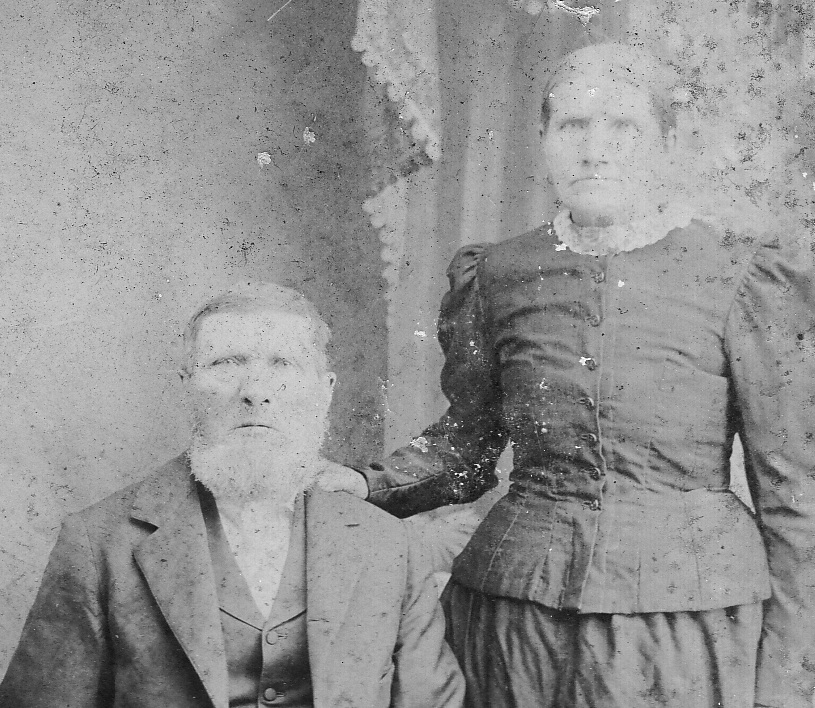
Fredrick and Marianne Heiden
Today is the birthday of Fredrich Carl August Heiden, my paternal 3rd great grandfather. He was born on September 15, 1832 in Mecklenburg, Nordwestmecklenburg, Mecklenburg-Vorpommern, Germany. He married Marianna “Mina” Allwardt while they still lived in Germany. Sometime in 1857, the young couple and their firstborn son, Theodore Frederick, immigrated to the United States via the port in Hamburg. On the 20th of June, 1857, the young family arrived in New York on the Charles C. Fowler passenger ship.*
Fredrich and his family lived in Bergholtz, NY when they first arrived in the USA, but at some point they moved west to Effingham County, Illinois. He and Mina had ten children, but three died in infancy. He supported his family through farming.
Fredrich died on the 21st of January, 1905 from Cirrhosis of the Liver, from which he had suffered for eight years.**
*Source Citation: Year: 1857; Arrival: New York, New York; Microfilm Serial: M237; Microfilm Roll: 175; Line: 36; List Number: 691.
**Effingham County, IL Death Certificate
On September 13, 1879, my 4th great grandfather, Josiah David Bates, died of Consumption* (Tuberculosis). Josiah was born about 1801 to his mother, Tabitha, and a father whose name is yet unknown. He was born in Pittsfield, Berkshire, Massachusetts and, except for possibly a short time in Weymouth, Norfolk, Massachusetts as a young man, he lived out his life in Pittsfield.
Josiah married Elizabeth Freeman and on New Year’s Day, 1824, she gave birth to their first son, Seymore (my 3rd great grandfather). Their second son, Ezekiel, was born about 1834. In 1860, Josiah was listed in the U.S. Census as a carpenter.
*Source Citation: National Archives and Records Administration (NARA); Washington, D.C.; Non-population Census Schedules for Massachusetts, 1850-1880 (T1204); Archive Collection: T1204; Archive Roll Number: 37; Census Year: 1880; Census Location: Pittsfield, Berkshire, Massachusetts; Line: 15.
Today in our family history, we remember Carl Aderman registering for the draft during World War I. There were three Selective Service “drafts” of young and older men for World War I. The first was on June 5, 1917 for men between 21 and 31 years old (this is the one when Rolland Woodington registered), the second a year later on June 5, 1918, and the last one was just two months before the end of the war. This third draft was held on September 12, 1918 (95 years ago today) and was the one Carl Martin Aderman signed up for when he was 34 years old. This draft was for all eligible men between the ages of 18 and 45. At this point in his life, Carl was living in Daggett, Michigan, was married to Floy (Bates) Aderman, and had four children between the ages of 4 and 11. Presumably he would have been classified as a “Class IV” prospect, defined as “Exempted due to extreme hardship. Married registrants with dependent spouse and/or children with insufficient family income if drafted, . . . ”
Here is a look at his hand-written draft card:


Gravestone of Moses, Henrietta (Munson), and Mary Ella Woodington
My second great-grandmother, Henrietta (Munson) Woodington died on this day, September 8, in 1882 at the age of 39. According to the 1870 U.S. Census information*, Henrietta was born in Ohio, maybe in Trumbull County where her parents, Amos Munson and Mary Ann Kearney, had married.
According to her gravestone, Henrietta was born in 1843. At some point, she had moved to Grant County, Wisconsin and, on December 16, 1859, when she was about 16 years old, she married** Moses Woodington. The couple had six known children: Furman Clarke (1860 – 1946), Lily Bell (1862 – 1872), George Franklin (1864 – 1926), Mary Ella (1867 – 1882), Virginia “Jennie” Lee (1871 – 1928), and Walter (b. 1877, death date unknown).
Henrietta died at a young age and their daughter, Mary Ella, died just four weeks later at the age of 15. Unfortunately, neither of their death certificates in Grant County, Wisconsin list a cause of death, so we will not know with certainty.
I wondered if there were any epidemics going through at that point in history that may have taken both women. According to the Report of the State Board of Health for the State of Wisconsin in 1882 (which can be found in Google Books), there was a milder smallpox epidemic that year even though a more primitive version of the vaccine was available.
Mike Nichols, in a Milwaukee Journal-Sentinel article, wrote of a diphtheria epidemic that killed five young daughters in the spring of 1882. Diphtheria was terrifically contagious and dangerous. Nichols wrote that sometimes even the undertaker would not handle the bodies.
Another curiosity: the death certificates were recorded several years after their deaths, in 1896. I do not know what this all means except that I am left with questions.
* Source Citation: Year: 1870; Census Place: Cassville, Grant, Wisconsin; Roll: M593_1716; Page: 87A; Image: 178; Family History Library Film: 553215.
**Source Information: Ancestry.com. Wisconsin Marriages, pre-1907 [database on-line]. Provo, UT, USA: Ancestry.com Operations Inc, 2000. Original data: Wisconsin Department of Health and Family Services. Wisconsin Vital Record Index, pre-1907. Madison, WI, USA: Wisconsin Department of Health and Family Services Vital Records Division.
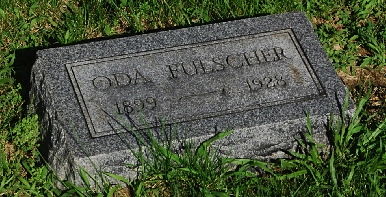
Oda (Bates) Fulscher gravestone in Lucas Chapel Cemetery.
Oda Bates Fulscher, my great grand aunt, died on this day, September 7, in 1928 at the age of 29. According to her death certificate, she died of “Nephritis–Uremia.” Interestingly, her father had died of “Chronic Nephrides” [sic] just two years earlier.
Oda was born August 31, 1899 in Logan County, IL, the daughter of Robert Josiah Bates and Marga Anna Radley. She was the youngest of their five children and was born several years after her next oldest sibling, my great-grandmother Floy, who was ten years old at Oda’s birth.
Oda had given birth to her only child, Harold Fulscher, in 1927 so he was just shy of 15 months old at her death. Besides her son and his descendents, one of the ways her legacy has continued is through one of our family stories.
Oda was only seven years old when her sister, Floy Bates Aderman, gave birth to her first son. Oda was insistent that Floy name the boy “Oda” and no matter how hard she tried, Floy was not able to convince the young girl that “Oda” was not a boy’s name. Then, loving her little sister as she did, Floy came up with the alternative–she named her son “Oscar Dearyl Aderman” so his initials would spell out “ODA.” Oscar honored that tradition again by naming his oldest son with the same initials.
My maternal 5th great grandfather, Azer Amos Reed died on this day, August 25, 1795, in the town of Hardwick, Warren County, New Jersey. Amos was born in Tranquility NJ sometime in 1730 to Azner Reed and Mary (or Martha) Youngs. He fought in the Revolutionary War 1776 – 1777 as a private, serving in Captain Jonathan Philips Company in the 2nd New Jersey Regiment.
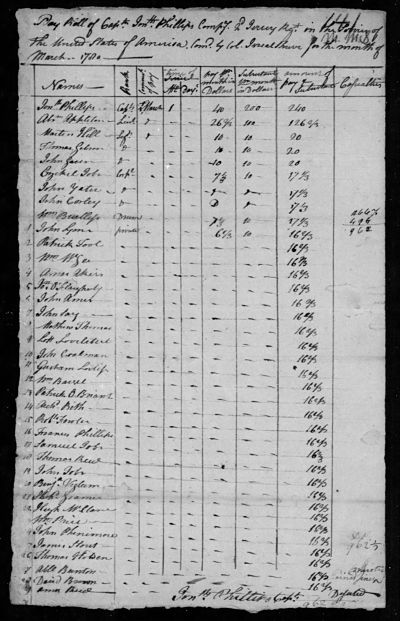
Amos Reed is the last name on the page.
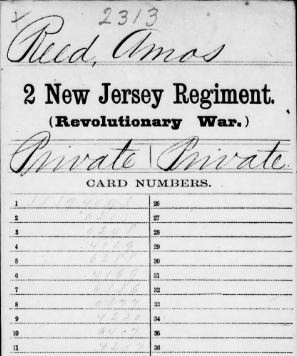
Amos Reed’s Revolutionary War Service Record
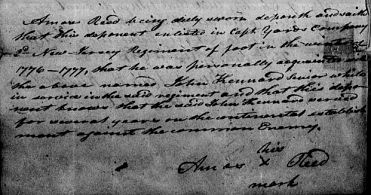
After the war, Amos vouched for John Kennard, stating that he knew him to serve in the war. It gives dates for Amos’ service.
Amos married Sarah Sutton, possibly in 1758, and they had two known children. Sarah, my 4th great grandmother, was born on Christmas Day in 1760 and Nathaniel was born five years later in 1765. At his death, Amos left the following will:
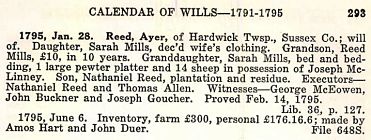
Azer Amos Reed’s Will.**
* Source Information: Fold 3
**Source Information: Ancestry.com. New Jersey, Abstract of Wills, 1670-1817 [database on-line]. Provo, UT, USA: Ancestry.com Operations, Inc., 2011. Original data: New Jersey State Archives. New Jersey, Published Archives Series, First Series. Trenton, New Jersey: John L Murphy Publishing Company.
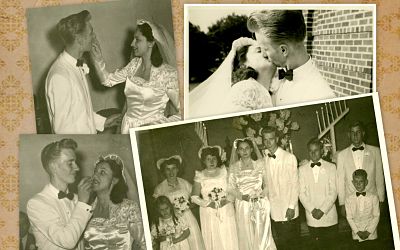
August 25, 1951

Colonial Drummer
I have written of Ensign Samuel Munson (1643 – 1693) and mentioned that he was the drummer for the Wallingford community in the New Haven Colony. Given that this job is no longer in use in our communities, I wondered what his responsibilities entailed. Here is a description of the drummer’s task in colonial English colonies:
“We do know that the drum came over to the areas of English Settlements with some of the very earliest colonists. Considered a most necessary adjunct to the art of war, the drum was also used for calling the people together for church services and town meetings. Some of the early churches were known to have been constructed so as to include a platform on which the drummer beat his “calls,” and records of many of these early communities indicate that tax assessments were often adjusted to meet the expense of hiring and maintaining a Town Drummer.”*
*Source: Ed Olson, Archivist-for-Life and Curator, The Museum of Fife and Drum.
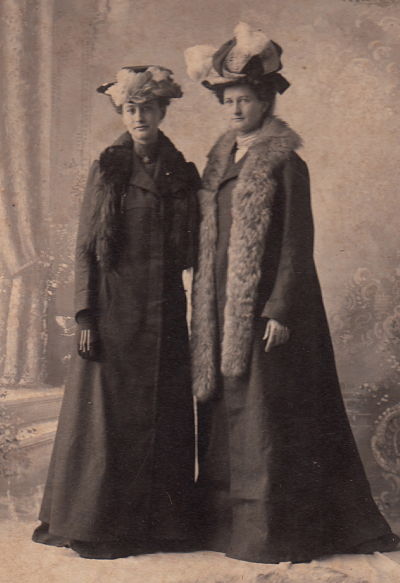
Olive Hope on the right with her sister, Florence.
Today is the birthday of Olive Meach Hope, my maternal grand aunt. She was born in Little Grant, Grant County, WI in 1879 and was the oldest of the four children of Michael William and Mary Ellen (Fralick) Hope.
Olive never married and spent most of her adult life in Salem, Kenosha County, Wisconsin where she was a teacher. My mother remembers she and her sister visiting their aunt in Salem during the summers between school years. Aunt Olive was very generous with Christmas gifts for her two nieces and bought Mom a trombone so she could play in the band.
Olive died on March 14, 1958 and was buried back in Little Grant Union Cemetery.
Mrs. June Aderman, wife of Arnold Aderman went into labor on the night of the tragic fire that burned St. Anthony Hospital in Effingham, IL. The Titusville Herald included this front page story, written by June, telling of her harrowing experience:

Woman Tells of Escape, Baby’s Birth
Mrs. June Aderman, 24, wife of Arnold Aderman, Effingham filling station worker, escaped from the maternity ward delivery room early today in the fire that destroyed St. Anthony’s hospital. Here is her story of her escape and the birth of her son later, as given to The Associated Press.
By MRS. JUNE ADERMAN
EFFINGHAM, Ill., April 5 [1949]–(AP)–
I think our family was the only lucky one in the fire.
About 8:30 last night I was taken to the hospital. I was put in the labor room with another girl.
About 11:30 a nurse took me to the delivery room.
In about 30 minutes I began to smell smoke. The nurse said she thought rubber gloves were being burned.
She went to investigate. But she came back and said nothing seemed wrong. But a minute later she went back into the hall.
It was filled with flames then.
The nurse slammed some double doors. Then she and another girl who was in the hall helped me to a window. We broke through.
Someone said the other girl in the labor room had jumped from the second floor. But later I heard she broke her back and lost her baby.
The three of us climbed out onto a roof. All we could see was straight walls down.
People seemed to be jumping from other parts of the building.
Some of them were sprawled on the ground.
Just then my husband and two other men ran up to the building with a ladder.
By then I was in labor on the roof. But the nurse, the other girl and I were able to climb down the ladder.
My husband rushed me home. We live about three blocks away. A short time later the baby was born.
My husband has named him Charles Lee, but everybody already is calling him “Lucky.”
My older boy, Tommy–he’s in the second grade–likes the name “Toughy” better.
But I guess time will tell whether he will be called Charley or Lucky.
June’s experience was also mentioned in the Miami (FL) Daily News:
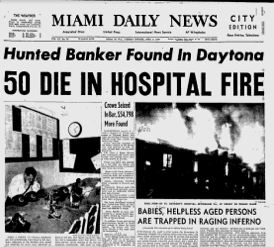
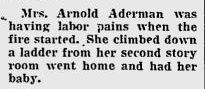
From the Miami Daily News, April 6, 1949.
Arnold Aderman* told the story a little bit differently in his interview with the United Press, as written on the front page of the Harrisburg (IL) Daily Register, April 5, 1949:
Baby Arrives After Mother’s Escape from Fire
(Editor’s Note: Arnold Aderman, a truck driver, watched his wife escape early today from the delivery room of St. Anthony’s hospital as flames enveloped the building. She was uninjured and gave birth to a son an hour after she was removed to her home. In the follow dispatch, Aderman tells of her escape.)
By ARNOLD ADERMAN
As Told to the United Press
EFFINGHAM, Ill, April 5–(U.P.)–My wife was in labor in the delivery room at St. Anthony’s hospital when it caught fire. She kicked the screen out of the window and climbed down a ladder against a roof off the second floor. I watched her come down.
Then we took her home. At 1:30 a.m. today, she had a boy. He’s our third child. We have Tom, 7, and Janet, 5. My wife’s a blue-eyed blonde. She’s 25.
She told me we ought to name the new baby “Lucky.” She’s the bravest thing I ever saw.
I was home asleep about midnight when I heard the hospital was on fire. I ran the three blocks to the hospital. I knew she was in there.
Baby Born at Home
When I arrived someone was pushing at the screen on the delivery room window, just above a roof. It was June. Flames and smoke were shooting all around. The firemen put the ladder up there. June knocked the screen out and crawled onto the roof. Then she started down the ladder.
I didn’t dare try to go up after her. I was afraid for her. I didn’t know what was going to happen. But she got down. I was there waiting for her. I took her to someone’s house across the street. Then we took her home. The boy was born about an hour after we got her.
Doc Westine–(Dr. J.C. Westine)–came over to see her. He was there when the baby was born. My father-in-law said it’s a miracle that everything tuned out okay. He said we’ve had the best luck in the world. He and my wife are right. We ought to name the kid “Lucky.”
*I believe Arnold Aderman, June’s husband, was the son of Adolph Aderman, who was the son of Gustav Aderman.
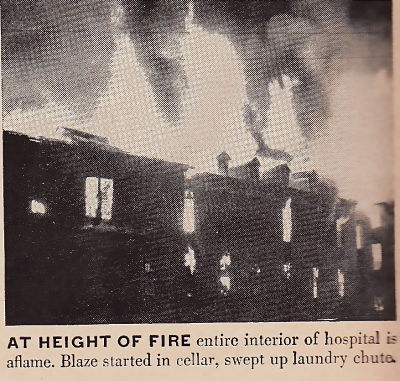
From LIFE magazine, April 18, 1949.
One of the worst hospital fires in US history took place in Effingham, IL on April 5, 1949. The city is the county seat of Effingham County where many of the Adermans and Heidens settled and had the only hospital in the county. In fact, Mrs. June Aderman was in the hospital when it caught fire and was fortunate to escape. Her story is referred to briefly in the news article below.
The United Press, a precursor to today’s UPI newswire, first reported the news of the fire this way:
57 DIE IN FIRE; EFFINGHAM HOSPITAL DESTROYED
BY: Hayden Bradford, UP Staff Correspondent Effingham, HI [sic]., April 5–A fire flashed through the 80 year-old St. Anthony’s hospital early today, trapping scores of helpless patients, and authorities feared that at least 57 persons perished. [Note: later, the Fire Marshall’s report raised the number to 74 plus one who died at another hospital later.]
Ten newborn babies died in the disaster, one of the worst hospital fires in the nation’s history. Another baby was born dead after its mother was injured critically in jumping out of a window. Shortly before 1 p.m., CST 34 bodies had been counted, 31 of them in the temporary morgue and three at other points. Of these, 26 were identified. The fire started shortly before midnight in the basement of the three-story building, which supposedly was fire-proof and had its own fire extinguishing system. The cause of the fire was not known. The flames shot up a laundry chute and swept through all floors.
Patients died in attempts to crawl through thick smoke and flames that filled the corridors. Others died in their beds, some with their limbs in casts or suspension slings. Fireman Charles Jaycee said about 12 patients jumped from windows, killing at least one and injuring several. Others were helped from first floor windows.
At least 15 persons were injured in escaping from the flames, police said.
Mrs. Wenton Sidney, 22, who was in a delivery room annex waiting to have a baby, jumped screaming from a second floor window, she suffered a broken back and right arm. Her baby was born dead an hour later. The bodies of nine other babies were recovered from the ruins and taken to an improvised morgue in a hall near the hospital.
Authorities said that another newborn child of Mrs. C.J. Springer died in the flames. Mrs. Springer escaped by jumping from a window. Much of the interior of the building collapsed. Floors and ceilings were piled on the bodies and authorities said the exact death toll might never be known, the hospital records were destroyed. Hours after the flames were put out firemen were digging through the debris and carrying bodies to an improvised morgue. The Rev. John J. Goff, pastor of St. Anthony’s church connected with the hospital, said the best estimate of the number of persons in the building at the time the fire started was 134.
These included, he said, 108 patients, three non-patients, a Miss Mary Kessler, and 22 nuns. Rescuers’ check lists showed that 57 patients and 20 nuns escaped. Miss Kessler died in the flames. The dead included Miss Fern Riley, 21, a nurse who refused to leave the babies and died a heroine apparently trying to save them, firemen said. Ben Bidenhorn was an ambulance attendant who helped victims from first floor windows. He received burns on his face and hands. He said he was asleep on the top floor when he was awakened by one of the sisters. “I saw smoke and opened the laundry chute, but I saw no flames and I hollered, ‘It’s downstairs.’ I ran to the elevator and when I got there I found the whole place was on fire, both the first and second floors.”
Frank Reis was the hospital engineer who lived next door. He dashed into the flaming building in an attempt to save his wife, a patient on the second floor. [Note: LIFE magazine of April 18, 1949 reported that Mrs. Reis jumped out of a window and, while badly injured, she did survive.] Some of the patients escaped by jumping from windows. One good story is about Mrs. Arnold Aderman who was having labor pains when the fire started. She climbed down a ladder from her second story room and was taken home and gave birth to a son. She and the baby were reported in good condition. [Mrs. Aderman’s story will be shared tomorrow.]
The Illinois State Fire Marshall investigated the blaze and offered a report of the scenario, witness statements, and possible causes for the fire and high death rate. Among his statements, he wrote:
Reconstruction of events in the early stages of the fire prior to and after arrival of the fire department force the conclusion that there was no effective organized rescue work and that those who escaped did so without assistance or with the assistance of nurses, nuns, and a few members of the Volunteer Fire Department. There is no evidence that the fire escapes were used to any extent or that the few ladders brought by the fire department were successfully used, excepting where some few people were taken from the roof of the one-story surgery section of the building by use of a fireman’s ladder.
The Effingham Volunteer Fire Department had 23 men respond to the alarm of fire, but most of these came sometime after the apparatus arrived on the scene. In view of this and of the attempted rescue work, the pumpers were not promptly put into action, but all three eventually delivered water on the fire.
In addition, and in response to a call for help over the Illinois State Police Radio Station at Effingham, paid and volunteer firemen came from the following named towns with their pumpers: Neoga, Teutopolis, Olney, Altamont, St. Elmo, Flora, Salem, Centralis, Sigel, Newton, and Matton. Some of these pumpers were put into service so that eventually eight pumpers were delivering water on the fire. However, the building was practically consumed by that time.
F. Delaine Donaldson, author of Effingham County: Transforming the Illinois Prairie (2010) wrote:
To understand the depth of emotion, one has to travel backward in time to the night of April 4, 1949, a night in which there was an overwhelming sense of surrealism. The sky over the city of Effingham was a strange pink with ornage color as a result of the fire that burned at the seventy-four-year-old building known as St. Anthony’s Hospital. Sirens screamed during the night as fire departments from throughout the area rushed into the town to the scene of great disaster.
The destruction did not take long–only about ten minutes, in fact–as fire quickly spread through the hallways of the building that held 120 beds. Firemen from Effingham and surrounding communities fought the blaze for about three hours before they brought it under control; then came the task of searching for the dead.
That tragic evening there were 128 patients, staff and visitors in the building; 77 of them died in the fire [Note: There may have been two deaths reported later as a result of the fire]. Temporary housing for rescued patients was quickly established, as was a morgue. There was also a headquarters for gathering information about the survivors and the deceased. Such headquarters, of course, was needed due to the confusion of the evening and the fact that many survivors were taken to other hospitals miles distant from Effingham County.
The emotion of the evening left its mark on the psyche of the area. The piteous screams of those who were burning or leaping from windows left a mark on the minds of people nearby, memories that could not be forgotten.
. . . The gruesome removal of bodies from the burned out building continued in the days following the fire. But a spirit of renewal and hope swept throughout the county as people began to talk about the need to rebuild the hospital . . . [and eventually enough money was raised to do just that.]
Today is the birthday of Marianne “Mina” (Allwardt) Heiden, my third great grandmother on my father’s side of the family. Mina was born in Germany on 12 Jul 1829. She married Fredrick Carl August Heiden, likely sometime around or before 1853 when their son, Theodore Frederick, was born. When she was 27 years old, she boarded the Charles Fowler ship with her husband and son, and immigrated to Illinois. The family arrived on 20 Jun 1857.
Mina and her family lived in New York for a period of time, then moved to Effingham County, IL. She gave birth to ten children, three of whom died in infancy. My great-great-grandmother, Mary Albertine Heiden Aderman was her sixth-born.
Mina lived a long life of 77 years and died of tuberculosis on 31 Jan 1907.


 Whence We Come