Floy Bates Aderman is in the lineage of the John Blue Family. Her great-great-grandfathers were brothers (Robert and John Blue) who married sisters (Ann and Elizabeth McNary). Robert and Ann had a son, Robert Blue; John and Elizabeth had a daughter, Martha Blue. Robert and Martha, first cousins, married each other and had a daughter, Elizabeth Ann. Elizabeth Ann was Floy’s grandmother.
Going back to the beginning (of this story, not of all time), Floy’s great-great-grandfathers (Robert and John Blue) had a sister named Ann (Blue) who married John Chambers. One of their daughters, Maria (or Mariah) married John Dull. At the beginning of the Civil War, John and their son, Thomas, signed up to serve in Co. H of the 1st Iowa Calvary. The men mustered in on the same day, August 10, 1861 just as the regiment was being formed. John was a farrier, taking care of the horses the Calvary used, and Thomas was a private according to the Civil War Soldiers and Sailors website.
That website also tells the work of the 1st Iowa Calvary. Like other Calvary units, they were involved in scouting activities and some battles. In the summer of 1862 they were split up for various military activity (remember that the Dulls were in Co. H) including the . . .
Guerilla Campaign against Quantrell’s, Porter’s and Poindexter’s forces July to September. Pleasant Hill July 8 (Co. “K”). Expeditions in Cass County July 9 (Detachment). Lotspeach Farm July 9 (Cos. “E,” “G,” “H” and “L”). Clinton July 9. Sears House and Big Creek Bluff, near Pleasant Hill, July 11 (Cos. “H” and “L”). Clear Creek, near Tabersville, August 2 (Cos. “A,” “G,” “H” and “L”). Kirksville August 6 (Cos. “A,” “G,” “H” and “L”).
One of the diaries of James H. Cowen was found many years later in the family attic. He served in the same company the Dulls were in, Co. H of the 1st Iowa Calvary. The diary tells of his experiences in the war from September 1862 to April 1863. There is even mention of John Dull on February 7, 1863. It is a wonderful read to understand something of the life of an enlisted man in the war.
In September 1863 the 1st Iowa Calvary was among those sent to capture Little Rock, Arkansas. This served to close off the territory west of the Mississippi and further isolate the South. Although both John and Thomas Dull survived the battles, John succumbed to what the Surgeon General’s office* (in Washington City, D.C.!) called “Remittent Fever” [sic] on October 19, 1863 and died in the General Hospital in Little Rock. Because the living conditions were so terrible for Civil War soldiers, the vast majority of deaths were not from battle, but from disease. Over the course of the war, the 1st Iowa Calvary lost two officers and 56 enlisted men in battle; two officers and 233 enlisted men died from disease. Thomas made it home safely; his father did not.
After the war was over, Maria and their son, Thomas, had to find new ways to move on.
*Fold 3: Widow’s Pension Application for Maria Dull, widow of John Dull.
In the not-too-distant past, it was a common practice for couples to have their engagement announced in the community newspaper. This was in an era when couples did not first live together, so the local paper would make a pubic announcement to the community of the couple’s change of status. Following are two examples from the Sheboygan (Wis.) Press announcing in their April 24, 1936 edition the engagement of Martin Boerner (John and Hilda’s son) to Miss Mary Primozich. The second example is Martin’s younger brother, Jacob Boerner being engaged to Miss Dorothy Reischl in the April 15, 1941 edition of the same newspaper.

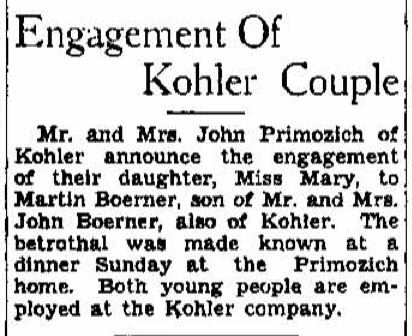

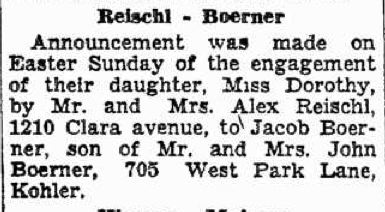
Back in the 70’s when this writer was an undergraduate studying microbiology at the University of Wisconsin-Madison (Go Badgers!), my calculator broke down in the middle of a calculus exam. Besides doing poorly on the test, I was left with the dilemma of trying to come up with $70 for a calculator that handled trigonometry functions. I lived on $50 a month (it was a different time!); calculators were a new invention (remember slide rules?) and were still quite expensive–especially when the same calculator today would sell for less than $20. I called home to see if my parents could help me out and Grandpa and Grandma were there visiting. Grandpa (Oscar Dearl) Aderman offered to pay for the calculator–an incredibly wonderful gift to this poor college student.
A few months later I was visiting Grandpa and Grandma in Niagara, WI and brought my new calculator along to show them. Before I continue, let me tell you something about Grandpa’s life. He had to quit school after the 8th grade because he was the oldest child and had to help support his younger brothers and sisters. He worked at a lumber camp in the winters from the ages of 13 – 18, then worked at home on the farm in the growing season. I always knew him to be an avid reader and envied his set of encyclopedias. I had not begun to recognize the depth of his knowledge!
I wanted to show him this great new calculator that he had paid for but I did not quite know how to explain sine and cosine and tangents, etc. to him with his limited schooling. As I was showing it to him, he got a wonderful look on his face, a look of “I think I might know something,” and invited me down to his workshop. When we arrived, he went to a shelf and pulled out an old trigonometry book, well-worn and blessed with occasional grease marks. In the back of the book were the tables for calculating sine, cosine, and tangent. He explained how he used trigonometry and those tables as he built the machines that he had developed over the years. He knew trig better than I did, learned it on his own, and used it routinely! I left in awe of him and plenty humbled.
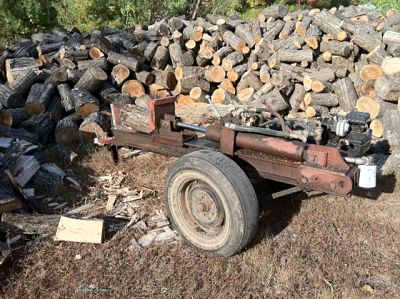
- The wood splitter made by Oscar Dearl Aderman, still in use today.
I was splitting wood yesterday with the wood splitter Grandpa made for Dad about 30 years ago. I suspect that trigonometry was used in the building of it. Of course, at the time and being a lumberjack of old, Gramps thought one would split wood with an axe. I remember his fascination as Dad told him there was a new invention out there for splitting with a machine. Could Grandpa make one? Well, he thought he might be able to. It is as solid as can be and still works great. His gift for building and for mathematics continues to touch us 22 years after his death.
One last thought: after Gramps died, I got to have his trigonometry book. It is one of my dearest possessions.
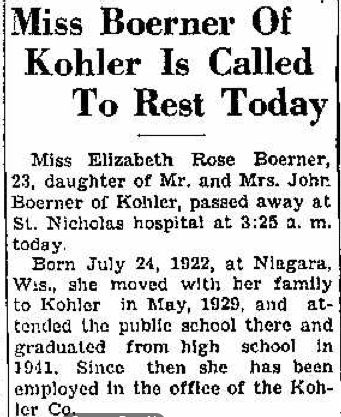
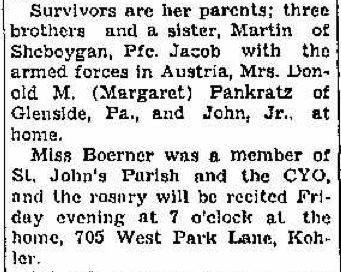
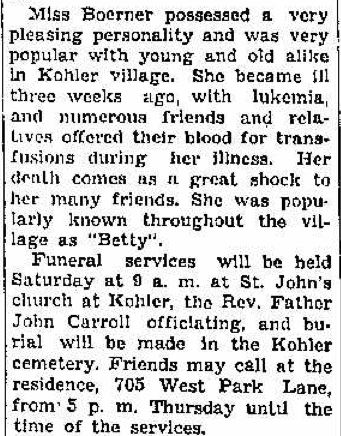
Martin and Katherine Boerner’s oldest son, John, went back to Germany to marry his cousin Hildegard Boerner. John and Hilda moved to Kohler, WI from Niagara, WI with their children in May 1929. They had five children who grew to adulthood. Elizabeth, their fourth-born, died at the age of 23 from leukemia. Here is the notice of her death in the Sheboygan newspaper.

On January 5, 1927, Ferdinand “Fred” Adermann succumbed to Carcinoma of the Stomach.* Three days later, on January 8, he was buried in Union Cemetery at Altamont, IL. According to the 1880 U.S. Census, Fred was born in Pottsdam, Prussia (he was living in Saint Francis, Effingham Co, IL at the time of the 1880 Census and living with “William Ederman” while working on the railroad). His death certificate information confirms that his parents were Christ Adermann and Friedericke Bergmann. The 1880 Census shows both Christ and Friedericke being from Pottsdam, Prussia.
His obituary:
MR. FERDINAND D. ADERMANN
———————————————–
Altamont Resident for Many Years Succumbs at Family Home in This City –
Funeral Services from the Emanuel Lutheran Church on Friday.
———————————————–
Mr. Ferdinand D. Adermann passed away on last Wednesday forenoon, a few hours after The Altamont News had come from the press. He was stricken ill only a few days before his passing, although his health had been below par for some time. It was not until December 28th that he allowed himself to stay in be on account of his weakened condition.
He was born in Biderkoph, Germany on February 11, 1859. His age, then, was sixty seven years, ten months and twenty four days. He was confirmed in the Lutheran faith in 1875. He came to this country with his mother and sisters and located in the Bethlehem neighborhood, during the late seventies.
Mr. Adermann was married on October 19, 1882 to Miss Mary Heiden, daughter of the late Mr. and Mrs. Fred Heiden. A year later Mr. and Mrs. Adermann moved to Altamont, uniting at that time with the Emanuel Lutheran Church, where they were always faithful members. Mr. Adermann was employed by the Pennsylvania Railroad for fifteen years. He then became an employee of the Baltimore and Ohio, remaining with this company until his death, or for twenty eight years.
Two brothers and four children preceded Mr. Adermann in Death. He is survived by Mrs. Adermann and eight children – Carl Adermann of Daggett, Michigan; Mrs. Henry DeJong of Springfield; Theodore Adermann of Mt. Pulaski; Mrs. Hulda Wassilak of Springfield; Paul Adermann of Lincoln; Mrs. Leonard Yocum of Detroit, Michigan; Alma and Wilbert, at home. There are also twenty one grandchildren, three sisters-in-law; four brothers-in-law, two sisters, other near relatives and many friends.
Following the death of their daughter Mrs. Durheim, almost eleven years ago, Mr. and Mrs. Adermann took the little son Harry, then seven months of age, to live with them.
Funeral services were held on Friday afternoon from the Emanuel Lutheran Church by the pastor Rev. M. O. Burkhardt, following which interment was at Union Cemetery.
* Death Certificate, State of Illinois Standard Certificate of Death Registration District No 244, Primary District No 4449, Registered Number 1. (This reference is found here.)
One of Monroe Hope’s favorite ways of sending mail was by sending postcards with his picture on the front. There was typically some sort of message that was probably better understood if the person really knew Monroe well–especially with his sense of humor. Below are two examples of those postcards.
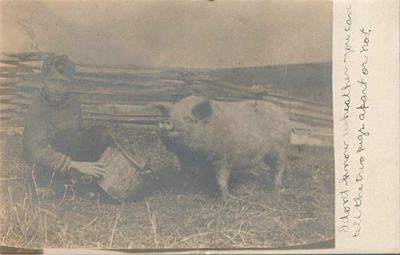
- Monoe’s postcard to his Aunt.
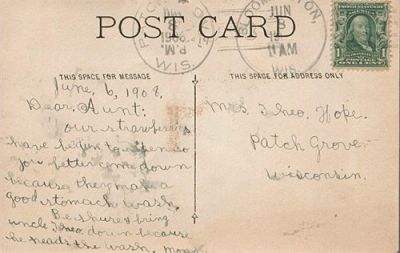
- The back side of the post card to his Aunt. (see above)
This card was sent to Ethel Woodington before they were married. She called him “Hopie.”
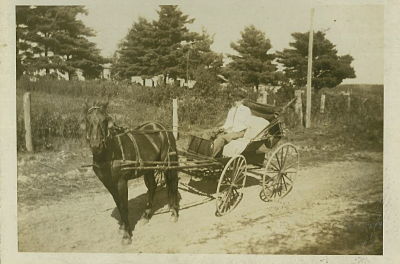
Monroe Hope ("Hopie") in a buggy.
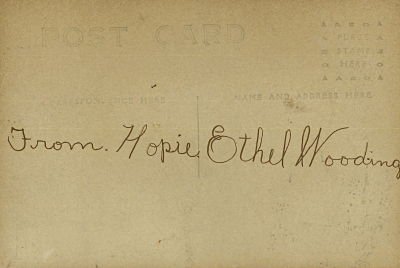
"From Hopie" to Ethel Woodington
This is a long post but has some fun information about the everyday military action that Moses Woodington and his brother, Jonathan, may have been involved in. They were in Company L of the 2nd Regiment of the Wisconsin Calvary, assigned to serve in the 3rd Brigade of the Calvary. These excerpts are from the Cornell University Library Making of America series, made possible by a grant from The Andrew W. Mellon Foundation. Several volumes of Civil War reports and correspondence has been published and has been scanned and uploaded here. This information is from Volume 49. Because of the OCR scanning process, some words did not convert accurately. I have corrected what I could do accurately; I left some misspellings where I did not know with certainty what the words should be.
MARCH 311, 1865.Expedition from Memphis, Tenn., into Northern Mississippi. REPORTS.
No. 1.Col. John P. C. Shanks, Seventh Indiana Cavalry, commanding expedition.
No. 2.Limit. Co]. Hugh Cameron, Second Arkansas Cavalry, commanding First Brigade.
No. 3.Lient. Col. Abel H. Seley, Fifth Illinois Cavalry.
No. 4.Col. Hasbrouck Davis, Twelfth Illinois Cavalry, commanding Second Brigade.
No. 5.Capt. Oliver Grosvenor, Twelfth Illinois Cavalry.
No. 6. Maj. Newton De Forest, Second Wisconsin Cavalry, commanding Third Brigade
Page 76
76 KY., S. W. VA., TENN., N. & C. GA., MISS., ALA., & W. FLA. No. 1.
Report of Col. John P. C. Shanks, Seventh Indiana Cavalry, commanding expedition. HDQS. CAVALRY DIVISION, DIST. of WEST TENNESSEE, Memphis, Tenn., March 22, 1865. Maj. W. II. MORGAN, Assistant Adjutant~ General: MAJOR: I have the honor to forward report of Col. J. P. C. Shanks, commanding detachment of division on a recent expedition into Northern Mississippi. Particular attention is called to the part of his report referring to the good conduct of the men of his command during the expedition. Very respectfully, your obedient servant, E. D. OSBAND, Col. Third U. S. Colored Cav., Comdg. Cav. Div., Dist. of West Tenn. IIDQRS. FIRST BRIG., CAV. DIV., DIST. OF WEST TENN., Camp Shanks, Memphis, Tenn., March 15, 1865.
CAPTAIN: I have the honor to report the following as my action while in command of the recent expedition into North Mississippi: In pursuance of orders from division headquarters I marched with the serviceable part of the First Brigade at 6 a. m. of the 3d instant, with two days rations in haversacks and 100 rounds carbine and twenty-five rounds pistol ammunition, and one mule and pannier for each twenty men to carry five days rations from point on railroad thereafter to be designated. At 9 a.m. I was ordered by Col. E. D. Osband, commanding division, to take command of detachments from First, Second and Third Brigades and move them to Germantown, with orders to leave 100 men from Second Wisconsin at Whites Station [NOTE: White’s Station was a railroad station just east of Memphis that was owned by the Memphis and Charleston Railroad, the first railroad to connect the east coast and the Mississippi River.], and during march to watch all movements in vicinity of Memphis and Charleston Railroad. These orders obeyed, I camped at Germantown at 3 p. m., First Brigade on south, Second Brigade on north, Third Brigade on west of ___ town~ posted 4 guards at all the houses inhabited. This and the two days previous it rained without ceasing. Distance marched, fifteen miles. At 4 p. m. Colonel Osband arrived on train with forage. March 4, called camp at 5 a.m.; remained in camp until 5 p.m., when train arrived with rations and additional forage. At 5 p.m. Lieutenant Colonel Funke, commanding Third Brigade, was ordered to return to Memphis with detachments Eleventh Illinois and Third U. S. Colored Cavalry. At 6 p.m., one days forage and ten days rations having been issued, five of which were in packs and five in haversacks, I marched from Germantown on the Collierville road in command of the expedition. My command consisted of the following detachments:
First Brigade, commanded by Lt. Col. Hugh Cameron,
Second Arkansas Cavalry Second Arkansas, Captain O’Brien commanding, 300 men; Fifth Illinois, Lieutenant-Colonel Seley commanding, 348 men;
Seventh Indiana, Major Simonson commanding, 370 men. Total, 37 officers and 1,018 men.
Second Brigade, Col. II. Davis, Twelfth Illinois, commanding Twelfth Illinois Cavalry, 228 men; First Iowa Cavalry, Colonel Thompson commanding, 471 men; Eleventh New York Cavalry, 295 men. Total, 38 officers and 994 men.
Third Brigade, Maj. Newton De Forest, Second Wisconsin Cavalry, commanding Second Wisconsin Cavalry, Maj. M. W. Wood commanding, 393 men; Fourth Illinois Cavalry, Capt. A. T. Search commanding, 267 men. Total, 660 men
Page 77 EXPEDITION INTO NORTHERN MISSISSIPPI.
My command consisted of officers and 2,672 men armed and equipped. I camped one mile southeast of Collierville at 9 p.m. on the Widow Browns farm. Distance traveled, nine miles. Second Brigade in advance this day. March 5, called camp at 5 a.m.; marched at 7, Third Brigade in advance, Second Wisconsin in advance of brigade. Advance and provost guards from this regiment. Fine country, but no farming being done. Detached squads on roads right and left. Forage scarce, but secured enough. Heard of the enemy in our advance giving notice of our approach. At Mount Pleasant their number increased to ten. Soon after passing this place the advance drove this squad hurriedly across Coldwater, swimming their horses after them. Major De Forest led this movement and relieved the command of these advertisers. Camped one mile southeast Lamar Station, on Mississippi Central Railroad, at 6 p.m., on farm of A. C. Treadwell. Distance marched, twenty-four miles. March 6, called camp at 4 a.m. and marched at 6. Order of march: First Brigade, Second Brigade, Third Brigade, Second Arkansas being in advance, and the advance and provost guard furnished by this regiment. This day bridges gone. Roads continue rough, much washed, and streams and low ground muddy. Reached Salem at 10 a.m. No information of our approach. I here learned that Colonel Crossland, in command of troops from Kentucky on their way to West Point to join Forrest, had reached Ripley two days previous, and with a possibility that they had not moved on, as they were looking for re-enforcements. This command was variously estimated at from 500 to 2,000. I moved promptly to intercept him, and was entering the town of Ripley with my column before noticed by the few soldiers found there. The advance, thrown forward [into] the town, led by Captain Moore, acting aide, caught most of the soldiers there, who were only a conscripting band. Colonel Crossland had marched southward thirty-six hours before my arrival, his command consisting of 300 cavalry. The latter portion of this day’s march was through a pine country. Forage very scarce. I camped the First and Second Brigades in an excellent position on southwest side of town, the Third Brigade on northwest, controlling roads on which troops would enter from Kentucky or Tennessee. Command got forage except a portion of the Third Brigade. I distributed the country for scouting and foraging among the several brigades. To the Third Brigade I assigned Salem, Sanisbury, Nubbin Ridge, or Pocahontas, and Ruckersville roads, with territory included; to the First Brigade (reduced by sending Fifth Illinois to railroad) the Booneville, Guntown, and Baldwyn roads; to the Second Brigade the Cotton Gin (or Kelleys), New Albany, Oxford, and lower Salem roads. I sent scouts on all the roads above mentioned from fifteen to twenty- five miles. On the Oxford road to Holly Springs Crossing, fourteen miles. On Albany road to New Albanya portion of this scout swam the Tallahatchie at New Albany in pursuit of a sqnad of rebels. On Cotton Gin road to Kelleys Mills and across and right and left along the banks twelve miles. On Guntown road to junction of Baldwyn road, eighteen miles. On road north of town from eight to ten miles. I had a guard placed at every house in the town. Marched by twos. Traveled forty miles. March 7, at 5 a.m. I sent Lieutenant-Colonel Seley with his command, and fifty men under Captain Wardlaw, Fourth Illinois, on road leading east to Booneville, on Mobile and Ohio Road, with orders to destroy that road from Booneville to Baldwyn as effectually as possible, and reach camp at Ripley on the 9th at noon; with further instruction (Page 78) that if he found to his satisfaction that that portion of the road included within his former instructions was being run under a truce between Major-General Thomas and General Forrest conditioned, as I had learned it was, that the road should not be used for military purposes then he should not destroy it. He found it under this regulation, and returned to camp the evening of the 8th at 5 p. m. A copy of his report* I herewith inclose [sic]and make part of this report. There were a number of cars loaded with corn for citizens carried under this arrangement. Colonel Seley deserves credit for the promptness with which he moved under these orders through the worst of roads with a scarcity of forage, the distance and return being near eighty miles. March 8, I sent Major Simonson with 200 men on Guntown road to junction with Baldwyn road to support Lieutenant-Colonel Seley, and on Colonel Seley’s return I ordered Major Simonson to return, He reached camp at 10 p. m. this day. I kept all approaches thoroughly scouted, turning the scouting party into a return forage detail when- ever no enemy had been discovered within the limits of their instructions. In this way I got forage and kept my camp strong at the same time. No enemy was found in force. March 9, finding no enemy north of the Tallahatchie, and the tenor of my orders, amount of my rations, condition of streams, bridges, and roads, with the great scarcity of forage in my rear and, in fact, north of that river, and the arrangement of neutrality upon the Mobile and Ohio Railroad rendering it unsafe to destroy it, thus at once depriving me of the power to materially injure the enemy, I judged it proper to return my command in as good condition as possible. Called camp at 5 a. m. and marched at 7 a. m. on Saulsbury road. Road narrow, washed in places, and streams and low ground very muddy. Order of march: Second Brigade, Third Brigade, First Brigade, Twelfth Illinois Cavalry in front and forming advance guard and provost guard. Weather bad. Captured Captain and Lieutenant Hammond, adjutant Fourteenth Tennessee. Camped on Grays farm, two miles southwest of Saulsbury. Distance marched, twenty-nine miles. Found forage sufficient for command by scouring the country from noon. March 10, called camp at 4 a.m.; marched at 6 a.m. Roads muddy; bridges gone. Compelled to march by twos. Order of march: Third Brigade, First Brigade, Second Brigade, Second Wisconsin Cavalry in advance. Advance and provost guards from this regiment. Reached Grand Junction at 9 a.m.; La Grange at 10 a.m. Captured three men at this place. Crossed Wolf River; crossing bad, bottom overflowed, and very miry. Marched to Sohos farm. Distance marched, twenty-four miles. March 11, called camp at 4.30 a.m.; marched at 7. Order of march: First Brigade, Second Brigade, Third Brigade, Second Arkansas Cavalry in advance. Advance and provost guards from this regiment. Issued stringent orders that no foraging be permitted. Having opened my left flank to the only possible forces which could be between the Coldwater and Wolf Rivers, I guarded that flank carefully, and learned from a citizen that Bill and Jesse Forrest were preparing to ambush me at some point near Collierville with a force stated at 800 men. I ordered Colonel Davis, with the effective force of his Second Brigade, over on the Holly Springs road, keeping his pack train and unserviceable [animals] with me. I hoped by this means to hold any force the enemy had between the Coldwater and Wolf, but found no enemy. My command reached Memphis at 9, and were in their respective camps at 11 p.m.
*See p. 81 Page 79 EXPEDITION INTO NORTHERN MISSISSIPPI. When within one mile of the pickets the front of my command was fired on by guerrillas, two of whom we captured and sent with charges to Irving Block Prison. Five escaped on horseback. I used every endeavor to protect private property, and for this purpose issued stringent orders against stealing. I directed each regimental commander to appoint a rear guard, with strict instructions to permit no enlisted man to pass or re-pass unless under detail with a commissioned officer. This, with the provost guard placed at every house and with the general diligence of officers, reduced straggling to small numbers; but permit me to say that a most stringent rule must be adopted to enforce compliance therewith, both with officers and men, before the command will be thoroughly efficient. Every straggler destroys his horse and otherwise wastes the public property intrusted [sic] to him. I found the citizens generally depressed. The poor simply asked for peace, and seemed to comprehend that it was their more wealthy neighbors who caused the war. The wealthy are as usual stealthy and corrupt, but their only question was, What is the best the Government will do? There is an evident feeling of doubt amongst them. The best information I could get was that Forrest was himself at West Point. His forces were variously stated at from 10,000 to 30,000. Jackson was said to be at Verona with from 1,000 to 5,000 said to be mounted, to be dismounted, and to be partially mounted, the last of which is probably true. His orders were to move south to join Forrest. The waters were very high; almost all bridges washed away. Roads muddy and much washed. The brigade and regimental commanders and Captains Reed and Moore and Lieutenant Koffman, of my staff, deserve mention for their promptness in the performance of their various duties. List of losses in men and material in the several regiments, as reported by their brigade commanders preparatory to this report, showing losses in respective regiments, except in Third Brigade. Losses and gains of stock are not designated:
[NOTE: here he reported particular losses of each brigade, but the table of numbers did not scan accurately onto the website.]
Page 80
80 KY., S. W. VA., TENN., N. & C. GA., MISS., ALA., & W. FLA.
Counting on deduction of four men lost, and twenty-eight men must have been dismounted, taking the reports as previously shown. This, however, is not true. In my opinion not one man walked into Memphis, unless to rest his horse. I am impressed with the belief that company officers cover deficiencies in horses by overestimates of losses on return from long scouts. This subject needs examination, and I have commenced it in my command. This report has been delayed on account of it, and is defective yet. Sixteen prisoners were delivered to provost-marshal. I am, sir, very respectfully, your obedient servant, JOHN P. C. SHANKS, Colonel, Commanding First Brigade, Cavalry Division, District of West Tennessee, and Comdg. late Expedition.
Capt. E. J. MEYERS, Acting Assistant Adjutant- General, Cavalry Division.
No. 2. Report of Lieut. Col. Hugh Cameron, & comm Arkansas Cavalry, commanding First Brigade. HEADQUARTERS SECOND ARKANSAS CAVALRY, Memphis, Tenn., March 13, 1865. SIR:I have the honor to report that on the 3d instant, with 300 men of the Second Arkansas Cavalry, at about 6 a. in., I reported to the officer commanding Cavalry Division, my command resting on Main street near the park, and was ordered by said officer to move out on Jefferson street half a mile, halt, and wait for further orders. At 8 a. m. I was placed in command of the First Brigade, 1,018 enlisted men, properly officered Seventh Indiana, 370, commanded by Major Simon- son, Seventh Indiana Cavalry; Fifth Illinois, 348, commanded by Lieu- tenant-Colonel Seley, Fifth Illinois Cavalry; Second Arkansas, 300, commanded by Captain O’Brien, Second Arkansas Cavalry and marched, with said brigade in advance, to Germantown, where I encamped. Distance, fifteen miles. March 4, 1865, subsistence and forage were drawn and the march continued twelve miles, via Collierville. March 5, 1865, march continued twenty-five miles, via Mount Pleasant and Lamar. March 6, 1865, the brigade in advance, marched to Ripley, via Salem, distance, thirty-eight miles. At this point (Ripley) my advance encountered and dispersed a party of rebels, capturing several stand of arms, some animals, and three prisoners. On the 7th instant a detachment from the brigade, comprising the Fifth Illinois Cavalry, under command of Lieutenant-Colonel Seley, was ordered out to destroy the Mobile and Ohio Railroad from Booneville to Baldwyn. For particulars of the scout see report of Lieutenant-Colonel Seley accompanying, marked B.* On the 8th instant a detachment from the brigade, comprising 100 enlisted men of the Seventh Indiana Cavalry and 100 of the Second Arkansas Cavalry, properly officered, commanded by Major Simonson, Seventh Indiana Cavalry, was ordered out on the Guntown road. For particulars of this scout see report of Major Simonson accompanying, marked A.t On the 9th the brigade marched to Sanlsbury, thirty-five miles; on the 10th to [Sohos] farm, via Grand Junction and La Grange, crossing Wolf River at the latter (See p. 81) place, twenty-five miles, and on the 11th, the brigade in advance, marched to Memphis, via Collierville and Germantown, capturing two bushwhackers, who fired upon the advance just outside of the pickets. Animals captured and abandoned by brigade. C I have the honor to be, & c., HUGH CAMERON, Lieut. Col. Second Arkansas Cavalry, Comdg. First Brigade. Col. J. P. C. SHANKS, Commanding Cavalry Division, in the Field.
No. 3. Report of Lieut. Col. Abel H. Seley, Fourth Illinois Cavalry. HEADQUARTERS FIFTH ILLINOIS VOLUNTEER CAVALRY, Memphis, Tenn., March 12, 1865.
COLONEL:
I have the honor herewith to report the part taken by this command during the late expedition into the State of Mississippi: After arriving at Ripley, on the 6th of March, instant, I was ordered to proceed with my regiment and fifty men of the Fourth Illinois Cavalry (leaving packs and disabled horses) and march to Booneville on the Mobile and Ohio Railroad, destroy the same from that point south to Baldwyn, and then return on the Baldwyn road so as to arrive at Ripley by 12 in. of the third day. I moved from camp at 6 a.m. on the 7th and arrived at Booneville, a distance of thirty-five miles, at 4.30 p. m. of the same day. I found the road very bad, and at the crossing of the East Talatchie nearly impassable, a recent heavy rain having flooded the swampy bottom, and washed the road entirely away. On arriving at Booneville I learned that the railroad track had washed away at points both above and below, and that it would require some time to repair it. I was also fully convinced that the railroad was operated under a flag of truce, and only for the purpose of carrying supplies to needy citizens living north of Booneville, and that no Confederate supplies nor Confederate troops were permitted to be carried over the road. This arrangement was in consequence of an agreement entered into between General Thomas, commanding Union forces, and General Forrest commanding rebel forces. Under these circumstances I did not feel justified in destroying the road, and, as I was informed that the Baldwyn road was impassable, I returned by the same road that I moved out on, camped two miles from Booneville, started on the morning of the 8th at 5:30, arriving at Ripley at 5 p.m. same day. During the day gave chase to three mounted rebels, capturing two of them. I could hear of no force of rebels nearer than Tupelo, where Forrest was said to be.
Page 82 82 KY., S. W. VA., TENN., N. & C. GA., MISS., ALA., & W. FLA.
During the entire expedition my command has captured 8 mules and 6 horses, which have been turned over to the quartermaster, and has lost 20 horses, which we were compelled to abandon. I have the honor to be, very respectfully, your obedient servant, A. II. SELEY, Lieutenant- Colonel, Commanding Regiment. Colonel CAMERON, Comdg. First Brig, Car. Div., Dept. of the Mississippi.
No. 4. Report of Col. Hasbrouck Davis, Twelfth Illinois Cavalry, commanding Second Brigade. IHDQRs. SECOND BRIG., Cavalry Div., DIST. OF WEST TENN., Memphis, Tenn., March 13, 1865.
COLONEL:
I have the honor to report that the Second Brigade, forming part of your forces on the recent expedition, moved out on March 3 with the following effective strength,. . .
We marched to Ripley, Miss., without any occurrence worthy of mention, except the loss of two men between Germantown and Collierville on March 4. These men belonged to Company C, Twelfth Illinois Cavalry, and, with another man from the same company, were, in violation of orders, foraging for corn in a barn, where they were captured by a few rebels. One of them escaped and reached Memphis in disguise, reporting that he saw the other two murdered. At Ripley Lieutenant-Colonel McQueen, with 100 men from the First Iowa Cavalry, was sent to the Tallahatchie, on the Cotton Plant road, where he remained till the division moved on the 9th instant. On the 8th a party of the Twelfth Illinois, under Lieutenant Pratt, swam the Tallahatchie and drove a party of twenty-five or thirty rebels out of New Albany without loss. The brigade marched with the division on the 9th, was detached on the 11th by the Marshall Institute road, and reached Memphis without accident on the evening of the same dpy at 11 p. m~ The losses of the brigade are as follows,
No. 6. Report of Maj. Newton Dc Forest, Second Wisconsin Calvary, commanding Third Brigade. HDQRS. SECOND WISCONSIN VOLUNTEER CAVALRY, Memphis, Tenn., March 13, 1865.
CAPTAIN: I have the honor to submit the following report of the part taken by a detachment of the Third Brigade, Cavalry Division, in the recent expedition to Ripley, Miss.: On the 4th of March, 1865, at Germantown, Tenn., by direction of Lieutenant-Colonel Funke, commanding the Third Brigade, Cavalry Division, Department of the Mississippi, I assumed command of a detachment of that brigade, consisting of the Second Wisconsin Cavalry, numbering 393 men, Maj. M. W. Wood commanding, and the Fourth Illinois Cavalry, numbering 267, Capt. A. T. Search commanding. The movements of this command being directed with the main column and under the supervision of the colonel commanding, require no particular mention in this report. The losses in the command were trifling, and are as follows: Five horses and 3 mules were abandoned. One man of the Second Wisconsin Cavalry was taken prisoner, but succeeded in making his escape, and returned to the column with the loss of horse and equipments, carbine (Spencer), saber, and accouterments. One male of this regiment died of disease at Ripley. The gain during the expedition was 6 horses and 3 mules, captured in the country. The march for a long distance over hard roads, and through a country poorly supplied with forage, was yet accomplished with little or no detriment to the condition or discipline of my command, and while there was no particular enterprise that deserves special notice, it is but simple justice to mention the creditable and uniform good conduct of the officers and men of my whole command. I am, captain, very respectfully, your obedient servant, N.DE FOREST, Maj., 2d Wis. Vol. Cav., Comdg. detachment 3d Brig., Cav. Div. (On late Expedition).
After another assignment, Major De Forest, who would have been Moses’ commanding officer, sent this report:
Official Reports from Major Newton De Forest, commander of the 2nd Regiment, Wisconsin Calvary and Lt. Col. Abel H. Seley of the 5th Illinois Calvary who went on the same expedition into Mississippi:
No. 6. Report of Maj. Newton De Forest, Second Wisconsin Calvary, commanding Third Brigade. HDQRS. SECOND WISCONSIN VOLUNTEER CAVALRY, Memphis, Tenn.,
March 13, 1865.
CAPTAIN: I have the honor to submit the following report of the part taken by a detachment of the Third Brigade, Cavalry Division, in the recent expedition to Ripley, Miss.:
On the 4th of March, 1865, at Germantown, Tenn., by direction of Lieutenant-Colonel Funke, commanding the Third Brigade, Cavalry Division, Department of the Mississippi, I assumed command of a detachment of that brigade, consisting of the Second Wisconsin Cavalry, numbering 393 men, Maj. M. W. Wood commanding, and the Fourth Illinois Cavalry, numbering 267, Capt. A. T. Search commanding. The movements of this command being directed with the main column and under the supervision of the colonel commanding, require no particular mention in this report. The losses in the command were trifling, and are as follows: Five horses and 3 mules were abandoned. One man of the Second Wisconsin Cavalry was taken prisoner, but succeeded in making his escape, and returned to the column with the loss of horse and equipments, carbine (Spencer), saber, and accouterments. One male of this regiment died of disease at Ripley. The gain during the expedition was 6 horses and 3 mules, captured in the country. The march for a long distance over hard roads, and through a country poorly supplied with forage, was yet accomplished with little or no detriment to the condition or discipline of my command, and while there was no particular enterprise that deserves special notice, it is but simple justice to mention the creditable and uniform good conduct of the officers and men of my whole command. I am, captain, very respectfully, your obedient servant, N.DE FOREST, Maj., 2d Wis. Vol. Cav., Comdg. detachment 3d Brig., Cav. Div. (On late Expedition).
Here is the Report sent by Lt. Col. Abel H. Seley for the same expedition into the state of Mississippi:
No. 3. Report of Lient. Col. Abel H. Seley, Fourth Illinois Cavalry. HEADQUARTERS FIFTH ILLINOIS VOLUNTEER CAVALRY, Memphis, Tenn.,
March 12, 1865.
COLONEL:
I have the honor herewith to report the part taken by this command during the late expedition into the State of Mississippi: After arriving at Ripley, on the 6th of March, instant, I was ordered to proceed with my regiment and fifty men of the Fourth Illinois Cavalry (leaving packs and disabled horses) and march to Booneville on the Mobile and Ohio Railroad, destroy the same from that point south to Baldwyn, and then return on the Baldwyn road so as to arrive at Ripley by 12 in. of the third day. I moved from camp at 6 a.m. on the 7th and arrived at Booneville, a distance of thirty-five miles, at 4.30 p. m. of the same day. I found the road very bad, and at the crossing of the East Talatchie nearly impassable, a recent heavy rain having flooded the swampy bottom, and washed the road entirely away. On arriving at Booneville I learned that the railroad track had washed away at points both above and below, and that it would require some time to repair it. I was also fully convinced that the railroad was operated under a flag of truce, and only for the purpose of carrying supplies to needy citizens living north of Booneville, and that no Confederate supplies nor Confederate troops were permitted to be carried over the road. This arrangement was in consequence of an agreement entered into between General Thomas, commanding Union forces, and General Forrest commanding rebel forces. Under these circumstances I did not feel justified in destroying the road, and, as I was informed that the Baldwyn road was impassable, I returned by the same road that I moved out on, camped two miles from Booneville, started on the morning of the 8th at 5:30, arriving at Ripley at 5 p.m. same day. During the day gave chase to three mounted rebels, capturing two of them. I could hear of no force of rebels nearer than Tupelo, where Forrest was said to be.
Page 82 KY., S. W. VA., TENN., N. & C. GA., MISS., ALA., & W. FLA.
During the entire expedition my command has captured 8 mules and 6 horses, which have been turned over to the quartermaster, and has lost 20 horses, which we were compelled to abandon. I have the honor to be, very respectfully, your obedient servant, A.H. SELEY, Lieutenant- Colonel, Commanding Regiment. Colonel CAMERON, Comdg. First Brig, Car. Div., Dept. of the Mississippi.
After two years of fighting in the Civil War, both the North and South had to legislate a draft for their military. Moses Woodington, like other men, was mandated to sign up for the draft of 1863-1865. He was 25 years old at the time, married, and in 18 months he would be fighting in the war*.
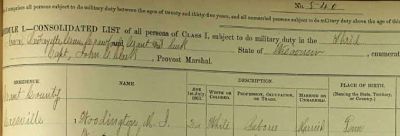
- Moses Woodington’s Draft Registration in 1863
According to the Civil War records, Moses and his brother Jonathan Woodington served in Co. L of the 2nd Wisconsin Calvary. They entered their military service on January 30, 1865 and mustered out (were released from duty) on November 15, 1865 in Texas. It was up to them to then find their way back to Wisconsin from Texas.
The war was, in large part, over and there was really only the major battle for Richmond, VA yet to happen. Yet, there was not a truce and fighting continued. On Palm Sunday, April 9, 1865, General Robert E. Lee surrender at Appomattox Courthouse, Virginia. Six days later, on Good Friday, President Lincoln was assassinated.
Through all of these events in the spring of 1865 and until the following autumn, the 2nd Regiment of the Wisconsin Calvary continued their work. According to Michael O. Varhola’s book, Life in Civil War America, at that point in the war soldiers were paid about $16/month. He writes, “From their pay, Union privates had $2 per month withheld until expiration of their terms of enlistment, and another 12.5¢ per month withdrawn for support of the Soldiers’ Home, a home for old or invalid military retirees” (p 127). A striking statistic of this regiment (and most others) is that the Regiment, in the four years of war, had 24 enlisted men killed and mortally wounded as well as 4 officers. Consistent with the terrible conditions of Civil War military life, 234 enlisted men died from disease. Total deaths: 312. It tells us something of the hardship Moses likely suffered.
According to the National Park Service’s Civil War Soldiers and Sailors website, in 1865, the 2nd Regiment of the Wisconsin Calvary was assigned to service in the 3rd Brigade of the Calvary Division. Late in the war, when Moses and his younger brother, Jonathan, joined up, the Brigade’s duty was in east Memphis, TN then marching through Mississippi to Texas. Following is material quoted directly from the CWSS website that details where the 2nd Regiment fought during the war. The bold, enlarged print is my editing to show the time when the Woodington brothers were there.
UNION WISCONSIN VOLUNTEERS
2nd Regiment, Wisconsin Cavalry
Organized at Milwaukee, Wis., December 30, 1861, to March 10, 1862. Left State for St. Louis, Mo., March 24, 1862. Duty at Benton Barracks, Mo., till May 15. Moved to Jefferson City, thence to Springfield, Mo., and duty there till June 14. Attached to Steele’s Command, Army of Southwest Missouri, Dept. of Missouri, to July, 1862. District of Eastern Arkansas, Dept. of Missouri, to November, 1862. 2nd Brigade, Cavalry Division, District of Eastern Arkansas, Dept. of the Tennessee, to January, 1863. 2nd Brigade, 2nd Cavalry Division, 13th Army Corps, Dept. of the Tennessee, to February, 1363. 3rd Brigade, District of Memphis, Tenn., Sth Division, 16th Army Corps. Dept. of the Tennessee, to June, 1863. Busseys Cavalry Brigade, Herron¿s Division, 13th Army Corps, to August, 1363. Cavalry Brigade, 17th Army Corps, to September, 1363. 1st Division, 17th Army Corps, to January, 1364. Winslow a Cavalry Brigade, District of Vicksburg, Miss., to December, 1864. 3rd Brigade, Cavalry Division, District of West Tennessee, to July, 1865. 2nd Brigade, 2nd Cavalry Division, Military Division Gulf, to August, 1865. Dept. of Texas to November, 1865.
SERVICE.-March to Batesville, Jacksonport and Helena, Ark., June 14-July 12, 1862, and duty there till January, 1863. Action at Yellville, Ark., June 25, 1862. Near Fayetteville July 15. Expedition from Helena to Moro August 5-8 (Detachment). Near Helena August 11. Near Helena September 19-20. Expedition against Arkansas Post November 16-21. Expedition to Yellville Noveinber 25-29. Expedition from Helena to Grenada, Miss., November 27-December 5. Oakland, Miss., December 3. LaGrange, Ark., December 30. Lick Creek, Ark., January 12, 1863. Clarendon Road, near Helena, January 15. Ordered to Memphis, Tenn., February 4, and duty there till May. Nonconah Creek, near Memphis, April 4. Expedition to Coldwater April 17-20. Horn Lake Creek May 18 (Co. “L”). Expeditions to Hernando, Miss., May 23-24, 26 and 28 (Detachments). Moved to Vicksburg, Miss., June 10-13. Siege of Vicksburg, Miss., June 13-July 4. Advance on Jackson, Miss., July 4-10. Clinton July 8. Siege of Jackson July 10-17. Canton July 12. Expedition to Yazoo City July 12-21, 1863 (Detachment). Bolton’s Depot July 16. Grant’s Ferry, Pearl River. July 16. Briar Creek, near Canton, July 17. Duty at Red Bone Church till April 27, 1864. Action at Red Bone Church September 25, 1863. Ingraham’s Plantation, near Port Gibson, October 10. Red Bone April 21, 1864. Moved to Vicksburg April 27, and duty there till December. Salem May 29 (Detachment). Worthington’s and Sunnyside Landings, Fish Bayou, June 5. Old River Lake or Lake Chicot June 6. Expedition from Vicksburg to Pearl River July 2-10. Clinton July 4. Jackson July 5-6. Clinton July 7. Expedition from Vicksburg to Rodney and Fayette September 29-October 3. Port Gibson October 1. Fayette and Cole Creek October 3. Expedition from Natchez to Woodville October 4-11. Woodville October 5-6. Fort Adams, La., October 5 and 7. Operations in Issaqueena and Washington Counties October 24-31. Expedition from Vicksburg to Gaines’ Landing and Bayou Macon, La., November 6-8. Expedition from Vicksburg to Yazoo City November 23-December 4. Concord Church December 1. Moved to Memphis, Tenn., December 8. Grierson’s Expedition to destroy Mobile & Ohio Railroad December 21, 1864, to January 15, 1865. Franklin Creek December 21-22, 1864. Egypt Station December 28. Expedition from Memphis to Marion, Ark., January 19-22, 1865 (Detachment). Duty at Memphis, Tenn., till June. Expedition into Northern Mississippi March 3-11. (Part of Regiment ordered to Grenada, Miss., May 9, and duty there till June 24, when rejoined Regiment at Alexandria, La.) Ordered to Alexandria, La., June, March from Alexandria to Hempstead, Texas, August 8-26, and duty there till October. March to Austin, Texas, and there mustered out November 15, 1865.
Click here to read reports sent from the officers of this brigade back to their superiors. It tells us something of what Moses and Jonathan experienced in the war.
* From the U.S. Civil War Draft Registrations Records, 1863 -1865.
Anna Marie Boerner Adermann (the grandmother of the writer of this blog) spoke of her older brother, Karl, who made the trip over from Gaulsheim, Germany but “died on the ship the day before they landed.” Yet, Ellis Island made note of Karl arriving on July 11, 1890 (see Passenger Record below).
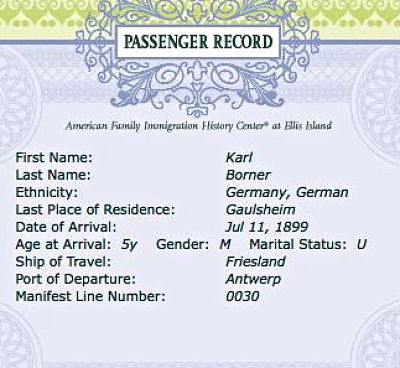
Registration Certificate for Karl Borner, age 5.
On the ship’s manifest for the S.S. Friesland there are 30 lines on each page of paper. In the margin next to line 12 there is a notation that five-year old Linke Gross (passenger #12) died on the trip on July 3, 1899. Her name and information has a line drawn through it. That left 29 people to account for once they arrived at Ellis Island. Also on this same page of the manifest, there is a hand-written note next to the Boerner boys: “in hospital.” Immediately next to that is an accounting of 29 – 3 = 26. Twenty-six would have been the number of people the captain would have had to account for from that page of the passenger list. (Immigrants going through Ellis Island were tracked by what numbered line they were on a page of the ship’s passenger list. There were 30 lines on this page, #12 died, #28, #29 and #30 were the Boerner boys.)
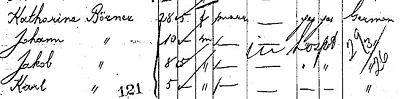
Ship’s manifest showing the Boerner boys “in hospital.”
Both the ship’s captain and the ship’s surgeon had to sign affidavits at the bottom of the page listing the passengers that they had inspected each passenger and found them healthy enough to be allowed into the U.S. There were a few question on the manifest testifying to the health (or problems) of immigrants. All of the Boerners were listed as healthy. Yet, so was the five year old Linke Gross (#12) who died just two days after they left Antwerp, Belgium.
This suggests the possibility that there might have been something contagious on the ship to which children were susceptible; it suggests all three boys were ill (or feared to be) but it was fatal to only Karl. If they were all in the hospital at Ellis Island, what might have that been like for them?
From http://sydaby.eget.net/swe/ellis_island.htm:
“After inspection, immigrants descended from the Registry Room down the ‘Stairs of Separation,’ so-called because they marked the parting of the way for many family and friends with different destinations. Immigrants were directed toward the railroad ticket office and trains to points west, or to the island’s hospital and detention rooms. During its half-century of operation over 3,500 immigrants died at Ellis Island and over 350 babies were born. 
There were three suicides. While doctors, nurses, inspectors, interpreters, matrons, and other staff employed during the station’s peak years generally followed the directive to treat immigrants with ‘kindness and consideration,’ the process of inspection and detention – and the frightening prospect of exclusion – remained overwhelming.”
If you have a subscription to Ancestry.com, here is the link to our family tree on Ancestry.com. It is a public tree and an ongoing work in progress. If you do not have a subscription but would like to register to this tree as a guest, contact me at cjaderman@gmail.com to request that. I appreciate Ancestry for the wealth of resources they have available and I am especially grateful for the number of extended family genealogists I have contact with because we share our public trees. The tree is, truthfully, a blend of good research data and family data. I use the tree as something of a collection site for my research so there is material on there which I have collected but not confirmed. I spend time on the tree looking for quality historical information to confirm the family histories which have been passed down. As I find it, I will make every effort to get it uploaded.
If you find corrections to it, please let me know. I will do my best to make it accurate. If I have borrowed information from your public tree–thank you! That is another of the gifts of the web and Ancestry. If you find information that improves your research–help yourself to it. Have fun exploring the tree.
CJ
Adam Boerner and his wife, Anna Marie Jens (“Amy”) were born and lived in Germany. They lived a comfortable lifestyle in their small town of Gaulsheim, adjacent to the city of Bingen in the Province of Hesse on the Rhine River. They had four children, Bartheleomeow (“Bartle”), Henry, Martin (the great great-grandfather of the writer of this blog), and Anna.
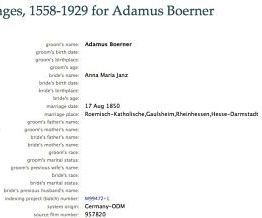
The marriage of Adam Boerner and Anna Marie Janz
Adam and Anna Marie continued to live in Gaulsheim until his death in 1895 and her death in 1907. Two of their children, Henry and Anna, remained in Germany; two of their sons, Bartle and Martin, moved to the United States.
Bartle came first to the United States while he was still a single man. He married here and settled in Kaukauna, WI. He and his wife had three children: William, Arthur, and Anna. He lived in Kaukauna except for one year when he took temporary employment in Niagara, WI. His family remained in Kaukauna that year.
Two years after Martin arrived in the United States, in 1899, Katharina and their sons, Jacob, Johann, and Karl set sail aboard the Friesland* to join her husband and their father in Wisconsin. Katharina was 28 years old and had waited in Gaulsheim, Germany for word to follow Martin to the States. It was a common practice at that time for the men to go ahead of their families to America and look for work and housing.
According to the ship’s manifest, Katharina had $10 with her when she boarded the ship. She, Johann, and Jakob could all read and write, but young Karl could not yet. They left Antwerp, Belgium on July 1, 1899 and arrived at Ellis Island on July 11, 1899. One of the advances in travel in the 1890s was that steamships replaced the old sailing ships. This cut down travel time from an average of three months, to two weeks or less.

Passenger List for the Friesland.
When Martin came over, he moved to Kaukauna, WI to live with his brother, Bartle**. The ship’s manifest reports that Katherina’s destination was also Kaukauna, WI to meet up with her husband; the boys with their father, and each of them had a ticket to ride the railroad to there Wisconsin destination. As the family story tells it, Martin and Bartle had gone up to Niagara, WI that year for work. Bartle then returned to Kaukauna, but Martin stayed in Niagara. According to the book, Niagara Falling, by Carol D. Miller, “Martin and Katherine Storck Boerner moved from Germany to Kaukauna, so Martin could work at the Badger Paper Mill, but the mill burned, so he and his brother went to Niagara to find work. Martin stayed at the Grand View Hotel. Eventually he brought his family to live in one of the Kimberly-Clark homes built behind the mill.” (Miller got this information from Garvaglia, 1976:13.) Martin’s family had joined him in Niagara by the 1900 U.S. Census, less than a year after their arrival at Ellis Island. The family became long-time residents of Niagara.
One of the tragedies of the journey to America was that five-year Karl died about the time they arrived. Family tradition says that he died the day before they landed at Ellis Island and the family had him buried in New York. Ellis Island records do have him arriving on July 11 but he was not on the family’s U.S. Census record the following year. In the ship’s manifest above, it looks like the phrase “in hospital” might apply to all three boys. Also on that page, the number of passengers changes from 29 to 26 if those boys were not released right away. More research needs to be done to settle this.
* Source: New York Passenger Lists, 1820 – 1957 and Ellis Island records for Karl Borner.
**Source: New York Passenger Lists, 1820 – 1957.
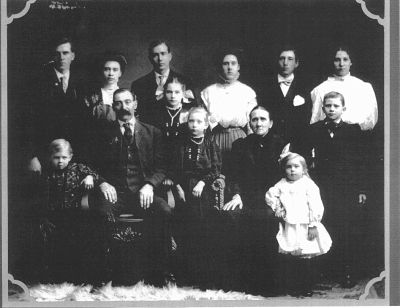
Ferdinand and Mary Ann (Heiden) Adermann Family
Here is the family portrait taken ca. 1908/9:
Back Row, Left to Right:
Carl, Ida, Henry, Ernestine, Theodore, Mary.
Front Row, Left to Right:
Wilbert, Ferdinand (father, seated), Hulda, Sophia (Vivian), Mary (mother, seated) Alma, Paul.
Fredrick Carl August Heiden and Marianna Allwardt were both born in Germany–Fredrick (or Fritz) in 1832 and Marianna (or Mary Ann) on 12 July 1829. They immigrated in 1857 on board the Charles C. Fowler passenger ship which took them from Hamburg, Germany to New York, NY. The family arrived at the port on June 20. Mary Ann was pregnant with their second child on the journey across the Atlantic. According to the ship’s passenger list, their son, Theodore, traveled with them on the journey.

Passenger List showing Fritz, “Mina” and Theodor Heiden
When they arrived in the United States, they lived in Berghotz, NY. Their second son, Henry Carl, was born in Berghotz on Dec 6, 1857 . Five years later, they moved to West, Effingham County, IL where they lived the rest of their lives. According to the ships’s passenger list and later U.S. Census information, Fred’s occupation in both Germany and Illinois was farming. Fred and Mary Ann died within 29 days of each other–Fred on Jan 2 1907 and Mary Ann on Jan 31, 1907. Fred’s cause of death was noted as cirrhosis of the liver*; Mary Ann’s was consumption of the lungs and pulmonary tuberculosis**.
Yet to determine: when were Fredrick and Marianna married? According to the 1990 U.S. Census, they had been married 43 years at the time of the census, estimating their marriage to be 1857. Maybe that is accurate, except their first born child, Theodore, was recorded as being three years old in June of 1857 when they immigrated (see image above). That would put his birth in 1853 or 1854. It seems more likely they would have married at or before that time.
* See http://www.ourfamilygenealogies.com/FamilyTree/35.htm
** See http://www.ourfamilygenealogies.com/FamilyTree/36.htm
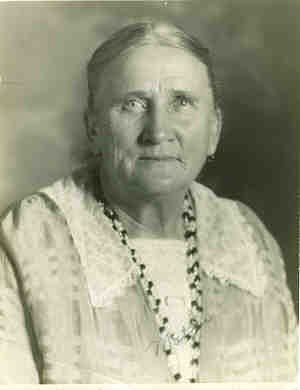
Mary Heiden Adermann
Mary Heiden was born on February 11, 1864, the daughter of Fredrick Carl August Heiden and Marianna Allwardt in Altamont, Effingham County, Illinois. She was the sixth-born of Fred and Marianna (Mary Ann) Heiden’s ten children and one of the seven who grew to adulthood. Of their ten children:
- Theodore Fredrick was born in Germany in 1853 and died in Gaylord, Smith County, Kansas on October 14, 1926. Theodore immigrated with his parents from Hamburg, Germany on the Charles C. Fowler passenger ship in 1857.
- Henry was born soon after Fredrick and Margaret immigrated to New York. He was born on December 6, 1857 in Berholtz, Niagara County, New York.
- A daughter was born and died in Holy Ghost Lutheran, New York, on December 11, 1860.
- A son was born and died in Altamont, Effingham County, Illinois on March 2, 1861.
- Johannis August Friedrich was born in Altamont on January 22, 1862 and lived almost 8 years before he died on December 28, 1869.
- Mary Albertine, who later married Ferdinand Adermann, was born on February 11, 1864 and died June 27, 1940.
- Ernestine (“Tena”) Wilhelmina was born January 7, 1866 in Altamont and died November 1945 in the same town.
- Fredrick Carl was also a lifelong resident of Altamont, being born there October 22, 1867 and dying October 25, 1952.
- Caroline was born March 5, 1870 and lived 65 years before dying on May 30, 1935.
- Louise lived less than four months. She was born in Altamont on May 16, 1873 and died on September 6, 1873. She was buried in the Bethlehem Lutheran Cemetery in Mound Township, Altamont, Illinois according to The Cemetery Records of Effingham County, IL, Vol 4, Bethlehem and Immanuel Lutheran Cemetery Records.


 Whence We Come