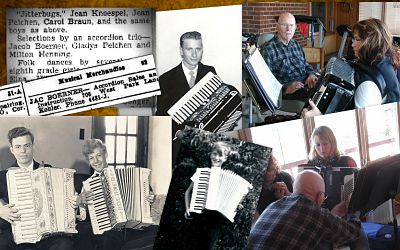
Accordion playing in the Aderman and Boerner families
A favorite musical instrument for some in the Aderman and Boerner families was the accordion. In Kohler, Wisconsin, Jacob Boerner had a thriving accordion business, playing for many local events, giving lessons, and taking care of others’ accordions.
In Niagara, Wisconsin, their cousin, Darrell Aderman, picked up the accordion at an early age and “took to it” as a favorite musical instrument. In High School, he took lessons on Wednesday nights after school from Ernest C. “Pines” Caviani (1897 – 1974), who lived across the river in Iron Mountain, Michigan. Mr. Caviani would travel to the houses of his students to give them lessons. Much like the Boerner brothers, Darrell played at banquets, dances, played in duets and trios (accordion, drums, tenor sax, and/or trumpet) on occasion. As accordion music would have it, country western and polkas were the most common style of music they played.
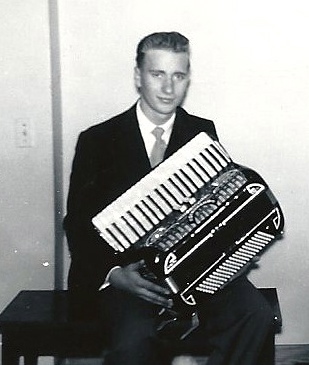
Darrell with his third accordion.
Darrell continued playing when he went to college and gave lessons in the towns Oregon and Evansville, Wisconsin to earn a little extra cash. He charged $1.50 for 30 -45 minutes and, like his teacher, would go to the houses of his students to teach them.
Once Darrell moved to northwest Wisconsin and worked as a public school music educator, he still gave accordion lessons in his home several nights each week. In the earlier years, he had an accordion band made of his students and throughout his years as a teacher, filled his schedule with students from all around the region.
Several years ago, my father and grandfather visited relatives in Illinois in part, to gather some genealogical information. Among the treasures they brought back with them were some family stories about Fredericke (Bergemann) Adermann, my 3rd great grandmother and the mother of Ferdinand Adermann. One of her grandsons, Wilbert “Feeley” Adermann (1904 – 1985), shared that Fredericke had been married five times. With that information, my Aderman cousin and genealogy buddy, Kevin, keeper of Our Family Genealogies, has done exceptional research on her and now much of her history is coming together. We know she was born 29 May 1829 in Prussia and I hope that by 29 May 2013 I am confident enough in my interpretation of the data we have that I can share it with you then.
In the meantime, I offer Fredericke’s obituary on this anniversary of her death, 23 Mar 1914. Since obituaries are written by the surviving family, they sometimes contain historical inaccuracies, but they do share the best “first hand” knowledge that a family has of their loved one. One historical fact: Fredericke and her fifth husband, August Laramee, died on the same day–a rare and fascinating phenomenon! Their obituary was on the front page of The Altamont News:
The Altamont News
Altamont, Illinois, Thursday, April 2, 1914
OBITUARY
———-
Life sketches of Mr. and Mrs. August Laramee, Old Residents of This Community – Funeral Thursday.
———-
An event that seldom takes place in any community occurred at Altamont on Monday of last week when August Laramee and wife answered the final summons, Mrs. Laramee in the morning, Mr. Laramee in the afternoon. The husband was unconscious during the entire day and did not know that his wife had died.
Funeral services were conducted from the Emanuel Lutheran Church on Friday forenoon in the presence of many relatives and friends, after which burial took place at the Bethlehem Cemetery.
Mrs. Fredericka Laramee was born in Germany, May 29, 1829. Her first husband, a Mr. Bergemann, died in the old country. She and six children came to America in 1871. Her second husband, a Mr. Adermann, died during the eighties. She was married to Mr. Laramee in April of 1893. Mrs. Laramee leaves the following children to mourn her departure: Mrs. Anna Mittelstadt* of Appleton, New York, Ferdinand Adermann of Altamont, August Adermann of Minnesota, Mrs. Fredericka Wachholz of St. Peter and Mrs. Fred Radloff of Altamont.
August Laramee was born in Germany, December 1, 1828. He came to America in 1857, settling first in New York. He later came to the Bethlehem community and moved to Altamont in 1909. He was married in March of 1860 to Wilhelmina Ploeger, who died in 1891. Mr. Laramee leaves the following children: Mrs. Lena Beccue of Milnor, North Dakota, William Laramee of Mt. Pulaski, Gus Laramee of Kansas, George and Ferd Laramee of Altamont.
*Mrs. Anna Mittelstadt is actually Anna Laramee, the daughter of August Laramee.
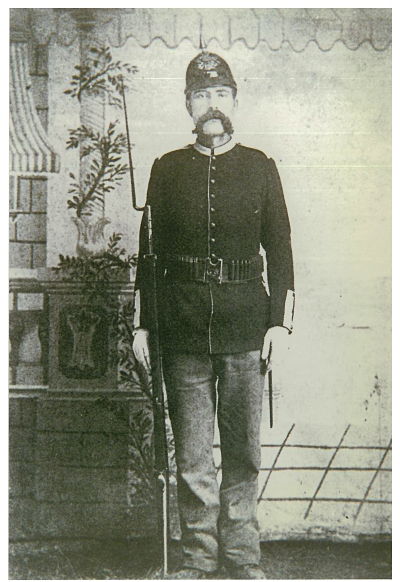
John Sturmer, Jr. in his U.S. Army uniform
John Sturmer was the oldest child of John and Barbara Clara (Barthen/Barton) Sturmer and the brother of my great-grandmother Dolly Sturmer. He was born July 21, 1854 in Beetown, WI. His first wife, Sarah Jane Mayne died from enteritis and after that he moved to Joplin, Missouri. There he married Olive Clementine Rule and had three children. He died on this day in 1897 from a mining accident and was buried March 24 in the Thurman Cemetery in Saginaw, MO. Here is an account of the accident from the Joplin Daily Glove, March 24, 1897.
Killed by Bad Air
John Sturmer the Second Victim of the Potter Shaft
The Potter shaft, on the O’Keefe land just east of the city, claimed its second victim within a fortnight yesterday morning. The victim was John Sturmer. The shaft is being sunk and had reached a depth of 90 feet. Monday morning it was noticed that the air was bad in the bottom of the hole, and one of the owners of the mine suggested to Sturmer that a sail should be put in. Sturmer rather resented the suggestion and intimated that he knew his own business the best. Yesterday morning at 7 o’clock Sturmer went to work. When he reached the bottom of the shaft his light went out. He saw the air was very bad and gave the signal to hoist him. When the hoister had gone up some 6 or 8 feet he evidently lost consciousness and fell out of the tub. When Sturmer fell out of the tub the hoisterman knew at once what was the matter and miners from near by came over. A light was let down in the shaft but it refused to burn. A sail was procured and this replenished the air so that men could go and bring Sturmer to the surface but it was apparent that the hour’s stay in the foul air had been fatal. Dr. Claycomb was on hand, but he could not, of course, render any assistance, as the man was dead. Matt Coyle and a Mr. Thompson took the remains to Undertaker Fletcher’s and Coroner Whitely was notified. The coroner came down and held an inquest just before noon. The verdict of the jury was as follows: “We the jury, find that John Sturmer came to his death by reason of bad air being in the shaft where he was working, and that, in our opinion, no blame is attached to the owners of the mine.” Sturmer was 43 years old and leaves a wife and three children in poor circumstances. They reside south of town on the road to Reding’s mill. He has relatives living in Wisconsin and his brother-in-law, A.H. Mills lives in East Joplin. The shaft where he was killed is the one where C.G. Potter met his death by being struck with a falling tub about two weeks ago. The funeral will take place from the residence this afternoon at 2 o’clock. Interment will be in Thurman cemetery.
Today is the birthday of my 3rd great-grandfather, Petrus Sturmer. He was born on March 16, 1779 in Filzen, Bernkastel-Wittlich, Rheinland-Pfalz, Germany, the youngest known son of Stephan Sturmer (1740 – 1807) and Maria Josefa Sidonia Klein (b. 1736). His oldest brother, Cornelius, was thirteen when Peter was born. Between Cornelius and Peter were three more siblings: sisters Maria Catharina and Anna Catharina and a brother Joannes.
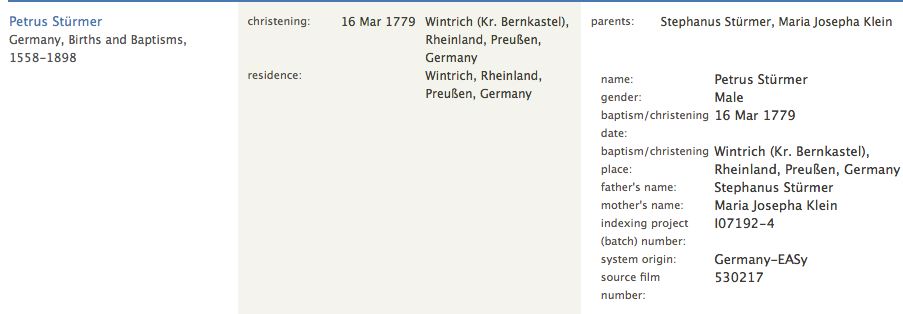
Baptismal Information for Petrus Sturmer from Family Search.
As an adult, Peter’s occupation was that of a shoemaker. This information comes from family history about his son, John. On 29 Nov 1815, Peter married Susanna Cornelius in the Roman Catholic Church in Filzen. Since we have a record of his brother, Joannes, being circumcised in the Catholic church in Filzen, it indicates the family belonged to the Roman Catholic church in their hometown.
Peter and Susanna had ten children: Peter, Jr., John (my 2nd great-grandfather), Antonius, Susanna, Maria Anna, Anna Barbara, Jacob, Gerardus, Elisabetha, and Maria Eva. I have not yet found the dates of death for either Peter or Susanna.
When their children grew up, Peter, Jr., John, and Jacob and two of the sisters (according to family stories) immigrated to the United States. John and Peter settled in Grant County, Wisconsin; Peter and Jacob went to California during the Gold Rush of 1849. Peter was killed on his way back home to Wisconsin and Jacob stayed in California.
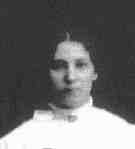
Mary Aderman Krumreich
Mary Aderman Krumreich, the daughter of Ferdinand and Mary (Heiden) Aderman, died in childbirth on this day in 1921, at the age of 28. She was born on May 17, 1892.
Mary married Paul Krumreich (who later changed his last name to Kennedy) on 20 Apr 1916. Soon after that they moved to Detroit, Michigan. They were living there the next year when their son, Kenneth, was born on 28 Aug 1917.
Mary died in Detroit after giving birth to their daughter, Vera Marie the day before. Following is her obituary in The Altamont News. (Note: the date of Vera Marie’s birth varies listed in the obituary is different from what my research has found.)
The Altamont News
23 Mar 1921
Altamont, Effingham, Illinois, USA
Obituary: MRS. PAUL KRUMREICH Miss Mary Adermann, daughter of Mr. and Mrs. F. D. Adermann, was born in Altamont on May 17, 1892, and passed away at Detroit, Michigan on March 11, 1921. The sorrowing husband and two children survive, Kenneth Stanley, who is three and a half, and Vera Marie, who is two weeks old. She was married to Mr. Paul Krumreich, at Springfield, on April 20, 1916. Following the marriage, they moved to Detroit. In addition to Mr. Krumreich and the two children, Mrs. Krumreich leaves her parents and four sisters and four brothers. With the exception of Carl Adermann, who lives at Daggett, Michigan, all of the brothers and sisters were present. Following the funeral from the Emanuel Lutheran Church by the pastor Rev. M. O. Burkhardt on Wednesday afternoon, burial was at the church cemetery. We extend our sympathy to the sorrowing ones.
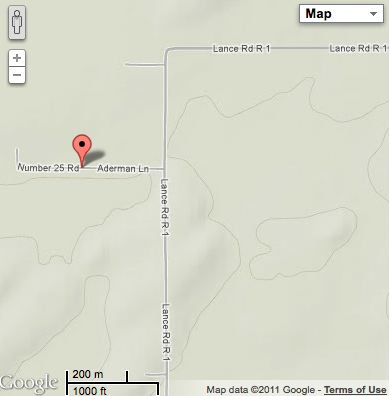
Lance Road and Aderman Lane outside of Daggett, MI
When Carl and Floy moved up to Daggett, MI in the early 1900s, they had a terrific amount of work to do clearing the land, raising food for their growing family, and making enough money to live on.
Neighbors needed each other more than we do today and their friendships ran deep. For Carl and Floy, Winford and Mae Lance were among their dearest neighbors. They helped each other with their farms and Mae also had skills as a midwife.
Their sons, Cyril Lance and Oscar Aderman grew up together and were lifelong friends. The two families farmed just a mile away from each other. Both boys were the same age and were in the same class in school. In adulthood, Oscar moved to Niagara, WI and Cyril moved to Madison, WI, but they stayed in contact over the years and the miles. Cyril and Myna are remembered as kind-hearted people. For example, they adopted two of Myna’s nieces, Bev and Jackie Lance, and raised them. Ralph, also known as “Hop”, was Cyril’s nephew, but Cyril treated him like a son.
Hop was raised by his Grandma Mae Lance in Daggett and went to High School there. When, during “the war years” (WWII) Winford and Mae, Carl and Floy had trouble getting help to work on the farms, Carl’s grandson, Darrell, and Winford’s grandson, Ralph (Hop) would go out and help with haying.
Oscar’s son, Darrell, attended the University of Wisconsin at Madison. That was a long distance from the northeastern corner of the state. At least once, Cyril and Myna were in Daggett visiting Winford and Mae at the same time Darrell was needing to get to Madison. Oscar took him to Daggett and he rode in the truck with them to Madison. As another courtesy, they would call him up every so often to visit them for the weekend.
While Carl and Winford were friends, and their sons Oscar and Cyril were buddies, the next generation of Darrell Aderman and Ralph “Hop” Lance were also longtime friends. Ralph went into the Navy after high school and, when he got out, attended the University of Wisconsin on the GI Bill. Darrell and Hop met up again in Madison where both men were attending college. This third generation of Aderman and Lance friendship was also demonstrated when Hop was the Best Man at Darrell’s wedding.
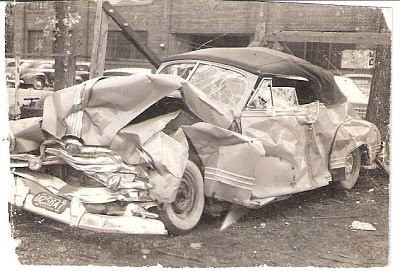
The Aderman car after the terrible crash.
The Lances helped out the Adermans in another major way during the college years of the third generation. Oscar and his family came down to Madison for a special university event. On their drive back, they were in a terrible car accident in which the driver of the other vehicle was killed and the Aderman car was totaled. All five members of the Aderman family who were in the car were seriously injured and taken to a hospital in Madison. One by one, as they were released from the hospital, they stayed with Cyril and Myna Lance until the whole family was out of the hospital and able to drive back to Niagara. Darrell repaid the Lance family by giving their daughter-in-law, Bev, accordion lessons for about three years.
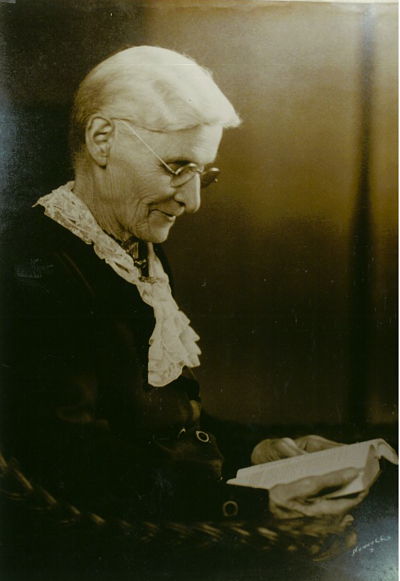
Mary Ellen (Fralick) Hope
One of my favorite pictures of my ancestors is that of my maternal great-grandmother, Mary Ellen (Fralick) Hope (1852 – 1935). She married Leander Gordon on the Fourth of July in 1868 and had one daughter before he died. She then married Michael William Hope (1840 – 1919) on September 30, 1874. Michael had immigrated from England as a 6-year old boy. Of their four children, the youngest and only son, Monroe, is my grandfather.
Mary Ellen was born in Grant County, Wisconsin and, except for a time that she lived with her daughter, Olive, in Kenosha, WI when she was in her latter years,* she spent her life time in Grant County. Her father, Henry Fralick (1812 -1896), was born on this day in 1812 in Montgomery County, New York and was christened May 31 , 1812, about three months after his birth, at the Reformed Dutch Church in Fort Plain, Minden Township, Montgomery, New York. As a young man he left New York and settled in Grant County, Wisconsin to farm. On Dec 4, 1844, he married Martha Scott (1819 – 1880) who had moved to the county from Ohio with her family.
Grant County in is southwest WI, with the Mississippi River as its western boundary. The 1895 plat book shows the river and where the Fralicks farmed.
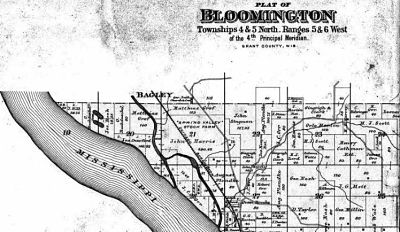
Grant County Plat Book, 1895.
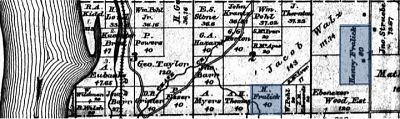
An “80” and a “40” farmed by Henry Fralick, highlighted in blue.
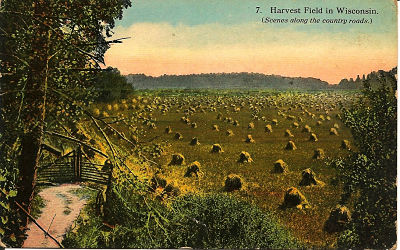
Hayfield in Wisconsin circa 1915.
Farming 120 acres was an impressive feat in the 1800s. They were among the larger farmers in the county with that much acreage. As they expanded their farm, they also expanded the amount of help needed to run it. The 1860 U. S. Census had Henry and Martha living there with their six children, Charles, Martha, Mary Ellen, David, Edward, and Frank (ages from 13 to 3). Ten years later, according to the 1870 U. S. Census, the value of their real estate had more than doubled to $3000 from its worth of $1400 in 1860. Their personal estate had tripled from $300 in 1860 to $900 in 1870. Additionally, in 1870, when Henry was in his late 50s he had more help on the farm. His oldest son, Charles, was 24 and living on the farm, presumably to help with the work. They also had two male farm hands living with them, ages 19 and 21, as well as a 12-year old white, female domestic servant. The two older daughters had married by 1870 and moved out, but Henry and Martha still had several school-aged children living at home. There were also four pre-school aged children, two with the last name of Ward and two with the last name of Haggard living in the household. At this point, their daughter Martha Jane had just married John Reynolds (and they spent most of their adult lives in Soldier, Jackson County, Kansas) and Mary Ellen was married to Leander Gordon. A mystery yet unsolved: why were these four young children living with them?
Henry died on Christmas Day, 1896; Martha preceded him in death on July 2, 1880.
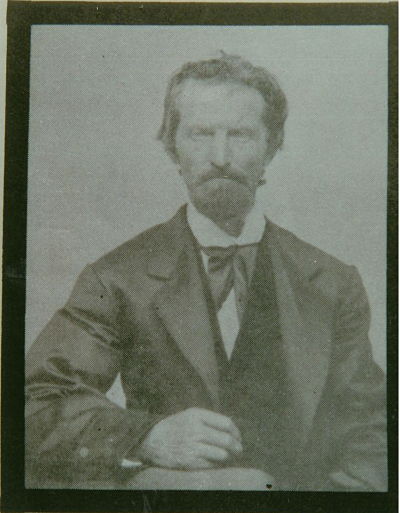
Henry Fralick
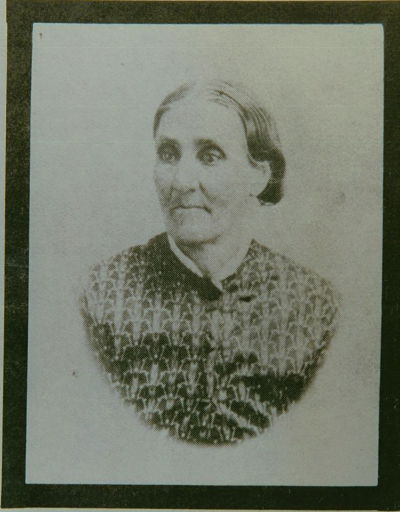
Martha (Scott) Fralick
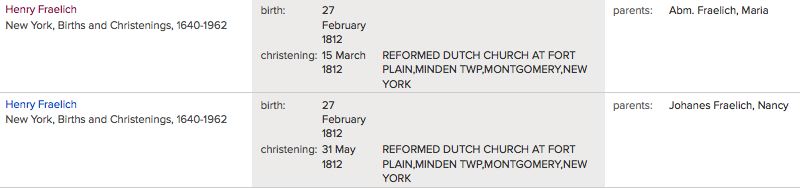
The cousins, both named Henry Fralick, both born on 27 Feb, 1812.
According to research on Archives.com, in conjunction with Family Search International, Henry’s father was Johanes and his mother was first name was Nancy. Apparently, Johanes’ brother, Abraham, had a son born on the same day, Feb 28, 1812. He and his wife, Maria, also named their son Henry.
*1930 U.S. Census
After Christian Adermann’s death, Fredericke Bergemann married William Adermann while they were both still living in Germany. Frederike had three known children with William: August Frederich (1867 – 1915), Fredericke (1870 – 1932) and Anna (1875 – 1949).
August Frederich was born 31 Dec 1867 in Prussia (1) and immigrated as a child with his mother and sisters (the year uncertain). He lived in Illinois with them for some years but then moved to southern Minnesota. He married Martha Bolter in Truman, Martin County, Minnesota when he was 35 years old, on 15 Jan 1903. (2)
August and Martha had five children with the oldest, their daughter Meta, being born in about 1903. The twins, William G. and Carl Otto were born in 1905, followed by Herman in 1910 and Herbert in 1914.
August died in 1915 when he was only 47 (3). Martha died three years later, in 1918, at the age of 40 (4). That left Meta at the age of 15 or so to raise her brothers. Martha’s parents and siblings had immigrated to the U.S. in 1900, so her parents, both in their 60s at this point, stepped in to live with Meta and her brothers. According to the 1920 U.S. Census, Meta as a 16-year young woman was the Head of the house, the house being owned at that point, free of a mortgage. Meta was no longer in school and one of the twins, 14-year old Otto, had quit school to be a farm laborer. According to the same census, Otto’s twin, William, had attended school that year and did not list an occupation. The youngest boys, Herman and Herbert were both at home.
What was life like for these orphaned teenagers? It surely must have helped to have their maternal grandparents living with them but there was still much work to do to fend and care for the younger siblings. Even though they had a home to live in, there was still the matter of providing food and clothing; the little boys needed to be raised. Meta and her brothers must have had to work hard and grow quickly, missing some of the activities enjoyed by their friends.
Interestingly, it seems that both Meta and Otto died at relatively young ages. Otto died in 1957 at the age of 51 when he tripped while carrying a gun and accidentally shot himself in the head. According to his obituary, Meta must have already died by then because she was not listed as one of the family members surviving him, although the three brothers were all mentioned.
(1) 1880 and 1900 U.S. Census, 1905 Minnesota Census
(2) Birth Certificate from Martin County, MN. Filed 26 Jan, 1903, Book E, p 299.
(3) Ancestry.com. Minnesota, Death Index, 1908-2002 [database on-line]. Provo, UT, USA: Ancestry.com Operations Inc, 2001. Original data: State of Minnesota. Minnesota Death Index, 1908-2002. Minneapolis, MN, USA: Minnesota Department of Health. State File Number; 001320, Certificate Number 001320, Certificate Year 1915, Record Number 170586
(4) Ancestry.com. Minnesota, Death Index, 1908-2002 [database on-line]. Provo, UT, USA: Ancestry.com Operations Inc, 2001. Original data: State of Minnesota. Minnesota Death Index, 1908-2002. Minneapolis, MN, USA: Minnesota Department of Health. Certificate #001793, Record #248845.
Ferdinand Aderman
On February 11, 1859, in Biedenkopf, Marburg-Biedenkopf, Hessen, Germany, Ferdinand “Fred” Adermann was born to Christian and Fredericke (Bergemann) Adermann. On his fifth birthday, while he was still a boy in Germany, Mary Albertine Heiden was born on the same day in Bethlehem, Effingham County, Illinois, USA, the daughter of Frederick Carl August Heiden and Marianna (Allwardt) Heiden.
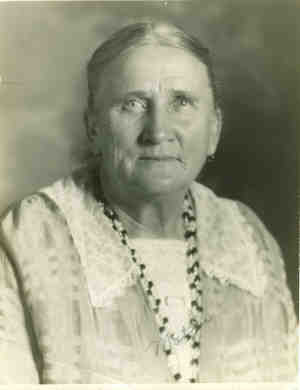
Mary (Heiden) Adermann
Some years later, Ferdinand immigrated to the United States and ended up in Illinois. On 19 Oct 1882, when he was 23 and Mary was 18, they married. That means they had 43 years of celebrating their birthdays together on the same day–February 11.
Martin Boerner, Sr.
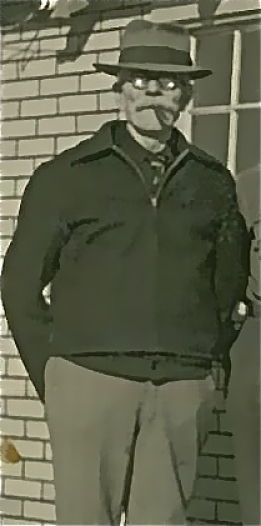
My great-grandfather, Martin Boerner, Sr. was born on this day, 9 Feb 1866, in Gaulsheim, Mainz-Bingen, Rheinland-Pfalz, Germany. He was the youngest of Adam and Anna Mariae (Janz) Boerner’s seven children.
As a young man he was in the “Kaiser’s Army” and did not like the direction the Kaiser was taking Germany, so he followed his brother to the United States. According to the 1900 U.S. Census, his brother, “Bartel” (Bartholomaus) came to Kaukauna, Wisconsin in 1886. Martin left his wife and three young sons in Gaulsheim and sailed on the Southwark, arriving at Ellis Island on 1 Dec. 1897.
He expected to work with Bartel at the Badger Paper Mill but the mill burned so they went up to Niagara, WI to work at the Kimberly-Clark paper mill. Bartel returned to Kaukauna but Martin made his home in Niagara, continuing to work at Kimberly-Clark. A family story tells of Martin being among the first employees of K-C in Niagara to receive a pension when he retired–a sum of $25 per month.
In 1899, his wife Katharine and their three sons immigrated to the United States. Young Karl died at Ellis Island but the other two boys survived. The family lived in one of the homes “behind the mill” and had four more children. Katharine died when she was only 45 when surgeons cut another organ while doing an appendectomy on her and she bled to death, leaving three young children at home for Martin to raise on his own. He did not remarry, but when his youngest daughter, Anna Marie, married Oscar Aderman, they bought the house from Martin and he lived with them for the rest of his life; Oscar and Ann and their sons lived upstairs and Martin continued to live on the ground floor.
Martin was a faithful Roman Catholic and made a big impact on his young grandsons. He is remembered for making apple cider each fall, for his strong work ethic, and his straight, deliberate, “military” stride. He lived well until his death in 1944 at the age of 78.
In the 19th century, tuberculosis or “pulmonary consumption” was a leading cause of death in the United States. The cause of the disease was unknown (it wasn’t until 1882 that a leading scientist in early microbiology research, Robert Koch, discovered the bacteria which causes TB), the mechanism of its transmission was not understood (it is spread primarily through the air) and there were no effective treatments to cure it when it was diagnosed (the development of vaccines and antibiotics was still in a primitive stage). The Center for Disease Control, the U.S. Public Health service also known as CDC, wrote an article about it and included the following insights:
Discovery of Mycobacterium tuberculosis (1882–1952)
At the end of the 19th century, romantic notions about tuberculosis were replaced by scientific ideas and products: vaccines and therapies, rest cures, tonics, lobectomies, pneumonectomies, thoracoplasties, “artificial” pneumothoracies, phrenic nerve crushings, plombage, pneumatic cabinet treatments, and antiseptic injections into the pleural spaces. Surgeons packed the pleural cavity with fat, paraffin, and even Ping-Pong balls. In contrast to the arts, science and medicine were unapologetically prosaic.
Over a 70-year span, tuberculosis literally transformed Western society. Tuberculosis patients were excluded from many occupations. Married patients had to sleep in separate beds from uninfected spouses and were counseled to avoid sex and especially to not have children. Public health nurses visited door to door, sanatoria were built by the hundreds, and hospitals added tuberculosis wings. Cold water hydrotherapy, alcohol massages, and brisk rubdowns with coarse towels were prescribed. Millions of spittoons and cuspidors were placed in homes and public places. Patients’ bed linens were changed daily and were boiled and laundered separately. Handkerchiefs (for those who could afford them—cut-up pieces of muslin for the rest) were stuffed in pockets before leaving home, then disinfected or burned at night. Japanese “paper handkerchiefs” became popular, leading eventually to the modern “facial tissue.” Tuberculous women had to forego corsets and brassieres in favor of loose-fitting clothes. Life insurance policies added clauses canceling benefits for the tubercular, and hotels and landlords refused to serve them. Compulsory registration, immigration bans, and even interstate travel restrictions were debated. Suicides in towns with sanatoria increased.
Prevention efforts were put in place. National antituberculosis programs were led by U.S. presidents. Ubiquitous “ad campaigns” featured catchy tunes some called “jingles.” Architects designed alcoves to hide concealed spittoons in middle-class homes. Babies were no longer allowed to play on the floor, and mothers were told not to kiss children on the mouth. Some churches abandoned the “common” communion cup. “TB” and “x-ray” became household words. Streets were watered down before sweeping to prevent aerosols. Long “trailing” dresses went out of fashion because they dragged on the ground and picked up potentially infectious dust. Store candies and bakery loaves had to be wrapped; public libraries and their books were regularly disinfected. (1)
I do not know in what ways our ancestors suffered the disease, but I have found two of them who died from “consumption”, what we now call tuberculosis or TB. The description of “consumption” deaths are difficult to read and I assume these dear progenitors suffered terribly.
On this day in 1907, my 3rd great-grandmother, Marianna (Allwardt) Heiden, died from “pulmonary tuberculosis.” Marianna was born in Germany on 12 Jul 1829 and immigrated on the Charles C. Fowler (2) to the United States, arriving on 20 Jun 1857 with her husband Frederick Carl August Heiden and their firstborn son, Theodore Frederick. She was pregnant with their second child, Henry, at the time.
When Henry was born, the family resided in New York but by 1861 they had moved to West Township, Effingham County, Illinois and made their home and farm. “Mina”, as she was called, bore ten children in all. Three of them died in infancy, one died at the age of 7 years, and the other six grew to adulthood. One of the six who grew to adulthood was their daughter Mary who married Ferdinand Adermann, another German immigrant living in the community.
People can carry the TB bacteria for many years and not have symptoms so Mary Ann could have carried the microorganism in her body for quite some time. According to the death certificate below, about four years before she died, Mary Ann became physically vulnerable enough that the bacteria could flourish in her body. She died at the age of 77 and was buried in the Bethlehem Lutheran Cemetery in Altamont, Illinois.
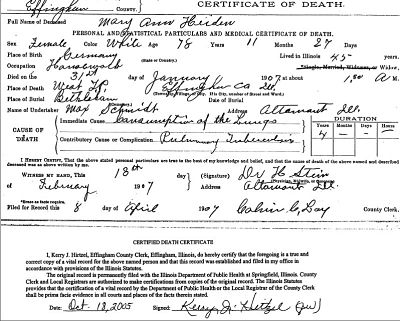
Death Certificate for Mary Ann Heiden
Some years before Mary Ann’s death, my 4th great-grandfather, Josiah D. Bates, also died from Consumption. He was born in Pittsfield, Berkshire County, Massachusetts in 1801 and spent his entire life in that community. Josiah married Elizabeth Freeman and they had at least two children, sons named Seymour (the future husband of Elizabeth Ann “Betsy” Blue) and Ezekiel. He supported his family as a carpenter.
According to the Massachusetts Town and Vital Records 1850 -1885, Josiah died on 13 Sep 1879 from Consumption (3).

Cause of Death is Consumption for Josiah D. Bates
The discovery of antibiotics helped make the disease manageable. Even though the number of cases of TB are currently on the rise again, the treatment for it far surpasses was what available a century ago. Here is to remembering the stamina and perseverance of two ancestors who suffered from “consumption.”
Notes:
(1) http://wwwnc.cdc.gov/eid/article/8/11/02-0549_article.htm
(2) Source Citation: Year: 1857; Arrival: New York, United States; Microfilm Serial: M237; Microfilm Roll: 175; Line: 36; List Number: 691. Source Information: Ancestry.com. New York, Passenger Lists, 1820-1957 [database on-line]. Provo, UT, USA: Ancestry.com Operations, Inc., 2010.
(3) Ancestry.com. Massachusetts, Town and Vital Records, 1620-1988 [database on-line]. Provo, UT, USA: Ancestry.com Operations, Inc., 2011. Original data: Town and City Clerks of Massachusetts. Massachusetts Vital and Town Records. Provo, UT: Holbrook Research Institute (Jay and Delene Holbrook).
One day at the Hope farm someone took a photograph of Michael and Elizabeth (Foster) Hope and their son and daughter-in-law, Michael and Mary Ellen (Fralick) Hope. There is not a date on the picture, but I am guessing it was taken in the late-1880s based on the ages of the individuals.
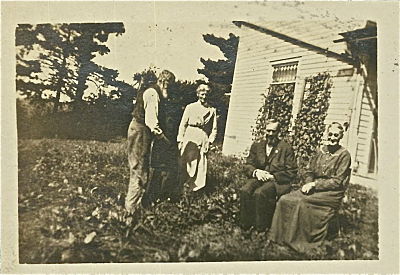
From L to R: Michael and Mary Ellen (Fralick) Hope; seated are Michael and Bessie (Foster) Hope.
An earlier post told about three generations of Michael Hopes immigrating from England to Grant County, Wisconsin via New Orleans and the Mississippi River. The family sailed to the United States in the fall of 1846 and within two years, Michael Hope (1814 – 1885) bought two parcels of land–about 72 acres–in Grant County. The family homestead was established and they lived in “Little Grant” for many years. In 1854, Michael bought another 40, and the following year he bought two more 40s. Below is an example of the land patent signed by him (thank you to the Bureau of Land Management records online!)
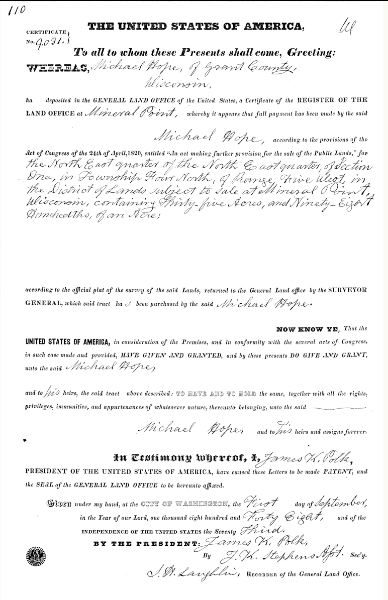
One of Michael Hope’s land patents.


 Whence We Come